Education
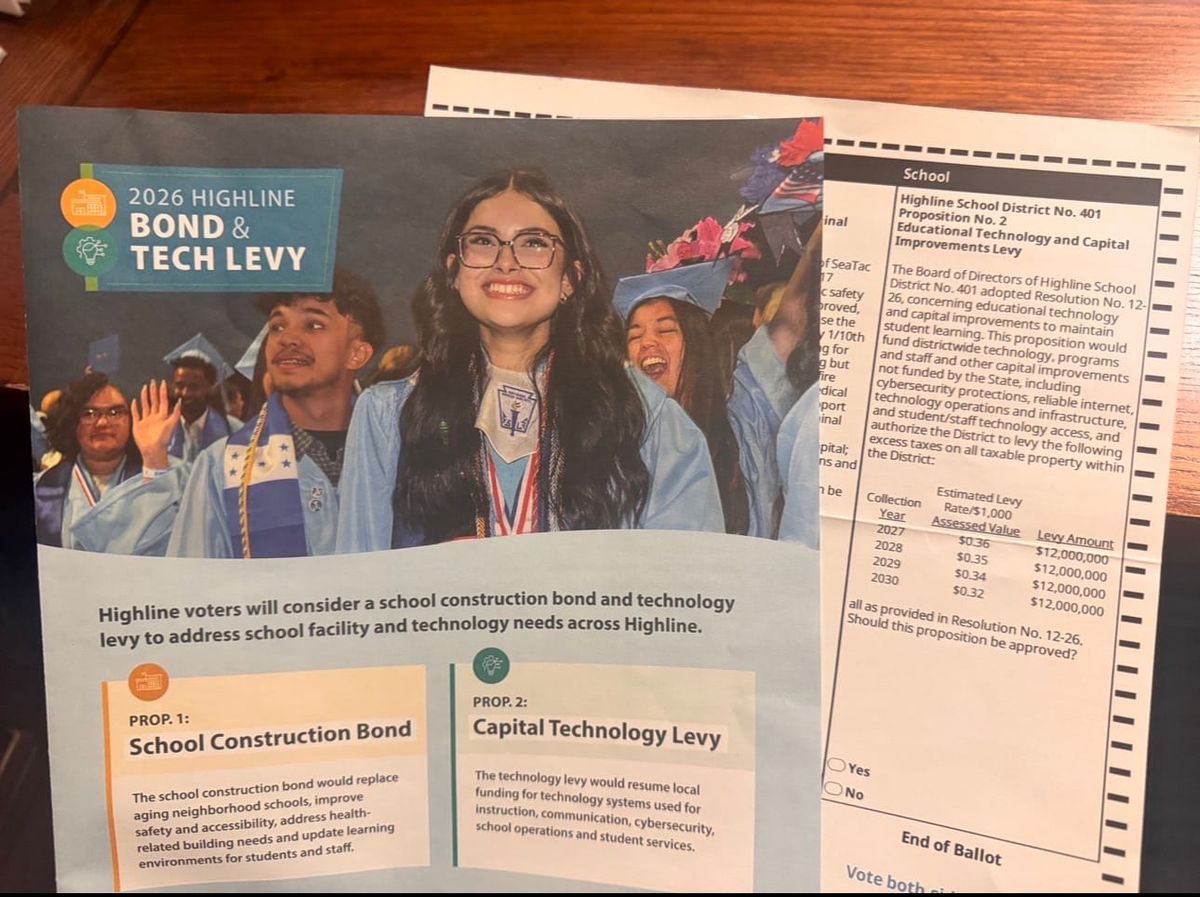
UPDATE | October 29. Original article posted October 23, 2026.
The Highline District has informed us that the cost per thousand is at 40 cents, 43 cents, and 58 cents for each of the next three years. For the owner of a $600,000 house this is an annual tax of $240, $268, and $376. See the bottom of this page for full update.
Be an informed voter. Bonds are more complicated than they appear.
Voters need full transparency about the costs taxpayers in the Highline School District are going to pay for the district’s $595 million bond and $48 million tech levy on the ballot.
The voter pamphlet does not provide the same cost information for both measures. Here is additional information to help clarify. This story will be updated as more information becomes available.
There are three key points:
1. The voter materials leave a gap
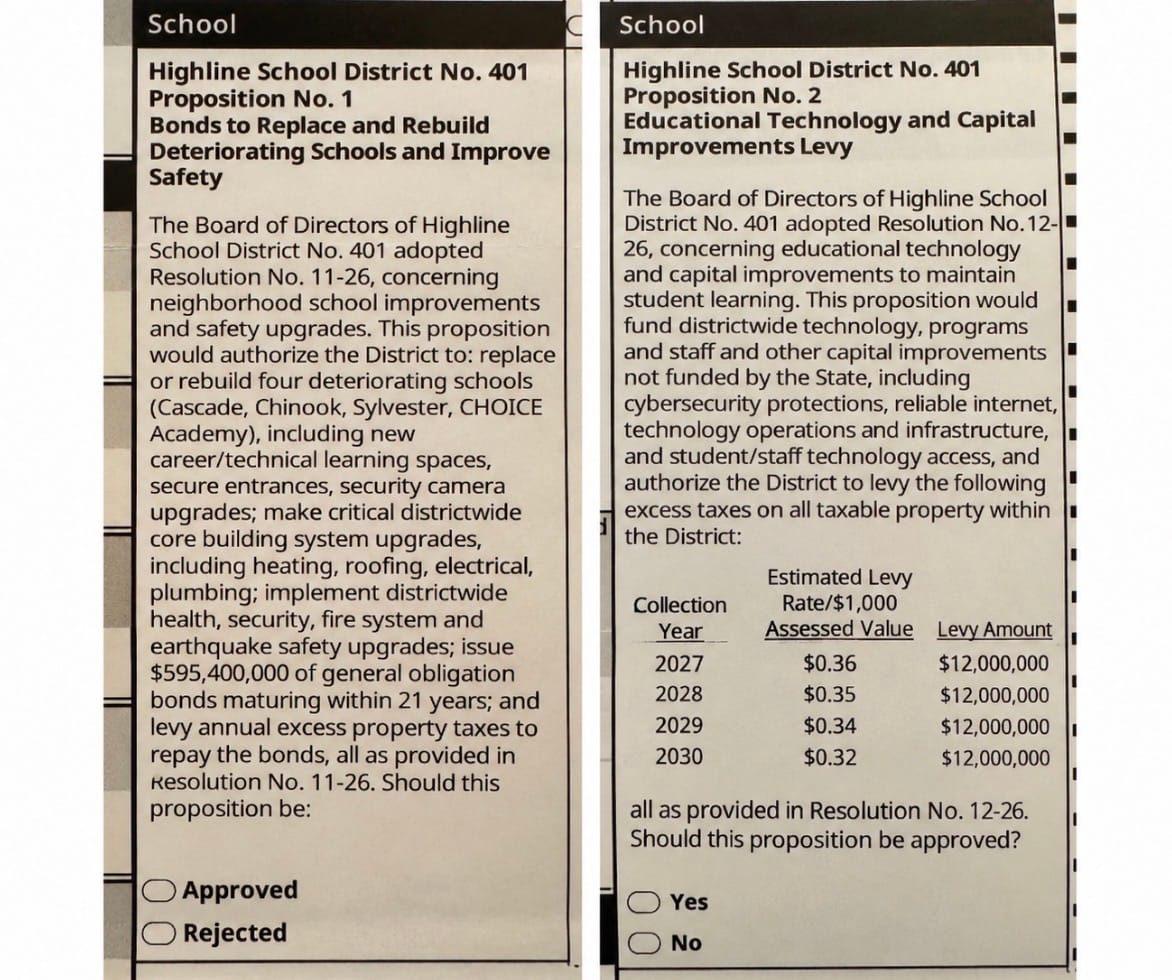
The tech levy information includes an estimated tax rate per $1,000 of assessed property value. The bond information does not include that same estimate.
Both ask voters to approve taxes. Providing comparable cost information would help voters understand what they are being asked to pay.
2. Your total local school tax includes more than these two measures
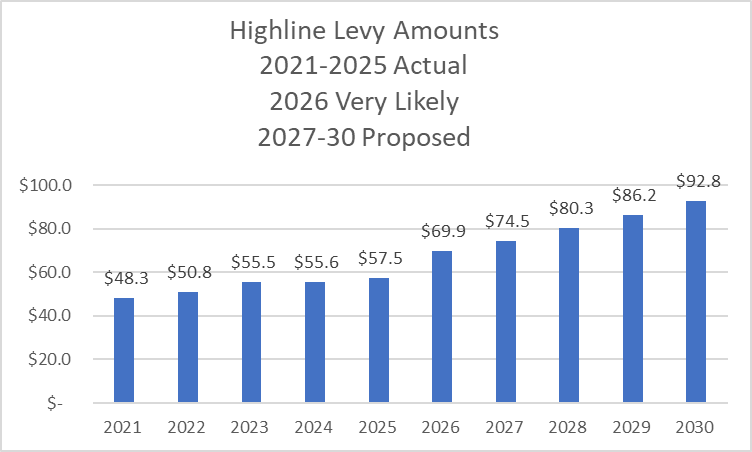
If you are wondering what your total cost of local school taxes is estimated to be, include the proposed bond, existing bonds, proposed tech levy and operations levy. Operations levy collections are already set to nearly double in 2030 compared to 2025.
Levy Fund Collections Set to Double in Less Than 10 Years
What is the Highline School District Levy? Is it a Renewal? Is it an Increase? The answer: both! The Highline School District’s 2027-30 operations levy on the Nov 4th ballot is both a renewal and an increase. It is a renewal of the previous levy that is expiring,
 Stuart Jenner
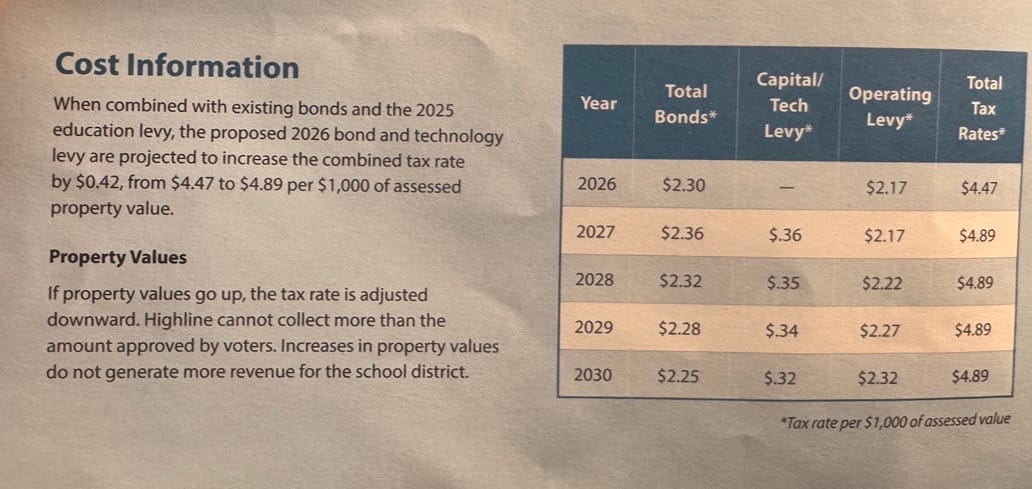
For a calculation including the proposed measures, use the combined estimated rate of $4.89 per $1,000 of assessed value, here is how to calculate the cost:
Assessed property value ÷ 1,000 × $4.89 = estimated annual local school tax.
That works out to $489 annually for every $100,000 of assessed value:
- A house assessed at $500,000 would have an estimated annual local school tax of $2,445.
- A house assessed at $800,000 would have an estimated annual local school tax of $3,912.
These figures represent the combined local school tax, not just the additional cost of the proposed bond and tech levy. They do not include the state property tax for schools.
3. Lower property values do not necessarily mean lower taxes
The district’s estimates assume property values will increase. However, if the district’s total assessed property value falls, the rate needed to collect the same tax amount rises.
Your individual bill also depends on how your property’s assessed value changes compared with other properties in the district. A lower property assessment does not guarantee a lower tax bill.
Ballots are due by November 3 at 8 p.m. Remember to vote.
UPDATE OCTOBER 29:
A Deeper Dive...
Based on October 29, 2026 response from Highline School District.
We received additional tax cost information from Highline School District communications that is important for voters to know.
The ballot measure gives an estimated total cost taxpayers will pay. The cost of the tech levy is specified at 36 cents per thousand. The construction bond information says there’s an increase of six cents. What was not included is the total estimated cost of the bond. This is higher than six cents because previously passed bonds are being paid off just before new debt is issued.
In order to provide a more transparent view, I looked at the assumed increase in valuation AND the projected tax rate per thousand of valuation. Thus, property assessed at $100,000 in 2027 is forecasted to be valued at $104,000 in 2028 and $108,160 in 2029. Here’s a summary table for a property valued at $600,000 in 2027, followed by explanations:
Estimated cost of what a taxpayer will owe for the new bond
Owners of $900,000 in assessed value would pay $360 in 2027, $402 in 2028 and $565 in 2029.
School districts and other entities attempt to keep tax rates smooth per thousand. But what voters need to keep in mind is they are approving $595.4 million in debt. The timing of when the bonds are issued then determines what the cost per thousand will be in two ways:
- The amount of debt
- The interest rate on that debt
The school district advisors make a best estimate of what interest rates will be at the time debt is issued. They have a buffer. However, there are never any guarantees.
From the district:
“The estimated tax rate for the new bonds is $0.40 per $1,000 of assessed value in 2027, $0.43 in 2028 and $0.58 in 2029. The overall district tax rate is projected to remain at $4.89 per $1,000 as rates for existing bonds, the technology levy and operating levy change over time. Our projections assume a 4% annual increase in assessed property values. This is the standard assumption we have used in our financial planning. Interest rates fluctuate, and we cannot predict what rates will be when bonds are issued. Actual rates will depend on market conditions at the time of issuance.”
Closing Comment
The only item that has a limit is the amount of debt that voters have authorized. They are not approving a tax rate per thousand or their own personal tax bill. If assessed values increase more than forecast, then rates per thousand drop. If assessed values decrease, or even rise but less than the four percent increase, the rate per thousand will be higher than forecast. The same is true for the tech levy, the estimated rates of 36 cents followed by 35 cents the following year are forecasts based on projected assessed value increases.
Members Discussion
Highline Journal Comment Guidelines
We believe thoughtful conversation helps communities flourish. We welcome respectful, on-topic comments that engage ideas, not individuals. Personal attacks, harassment, hateful comments, directed profanity, false claims, spam, or sharing private information aren't allowed. Comments aren't edited and may be removed if they violate these guidelines.