Editor’s Note: The following guest opinion was submitted by former Burien resident and published author Debi Wagner.
Every major airport expansion is sold the same way: jobs, connectivity, economic growth.
The pitch is always forward-looking, always optimistic, always framed as progress the community should welcome. What the pitch never mentions is the cost already being paid by the people who live under the flight paths — a cost measured in asthma, hypertension, sleep loss, and elevated cancer risk, and a cost that is about to get dramatically worse.
A Plan for Industry Growth
The Sustainable Airport Master Plan (SAMP) provides nothing that is sustainable except the industry’s growth.
The plan would add 80,000 annual operations (or more), pushing the total to 540,000 flights a year. That is not a marginal increase. It is a doubling of the burden on neighborhoods that are already sick.
What the Health Data Shows
The health data tells the story before any model does. A 2020 analysis found that communities around the airport have significantly poorer health outcomes than other areas of the county, and the pattern is unmistakable: the closer you live to the airport, the worse the outcomes.
That gradient, which is a clear dose-response relationship, is exactly what you would expect if the airport were the driver. It is the kind of pattern epidemiologists treat as strong evidence of harm, even without proving causation molecule by molecule.
The airport’s response is the familiar one: you can’t prove causation.
But that demand for individual-level certainty is a standard science rarely meets for environmental exposures. Population-level association, especially with a dose-response gradient, has been the basis for action on everything from leaded gasoline to secondhand smoke.
The community is already carrying measurably higher rates of the exact conditions linked to aircraft noise and emissions. That is the injury. Waiting for a perfect causal chain is not caution — it is delay dressed up as rigor.
The Greater Danger Comes During Landing
And the emissions problem is worse than the industry admits, because the worst of it happens on landing, not takeoff.
On approach, engines run at low thrust, combustion is incomplete, and the exhaust plume stays dense and close to the ground. Ultrafine particles and other combustion byproducts from Jet A fuel settle over neighborhoods at a much higher rate than during takeoff, when engines burn hot and climb fast, lofting most of the plume above the rooftops.
The industry spent decades buying out homes under departure paths to quiet the noise complaints. They left the landing patterns untouched, with all the population intact.
So the people under the approach paths are getting a far greater dose of ground-level emissions than anyone under the takeoff paths, which shift with the wind.
That asymmetry shows up in the health data itself. The north side of the airport receives most of the landings in a given year, and its asthma and illness rates are worse than the south side, which sees fewer landings.
The landing pattern is not a minor detail - it is the primary exposure pathway, and it has been ignored in every mitigation effort.
Emission Numbers That Do Not Add Up
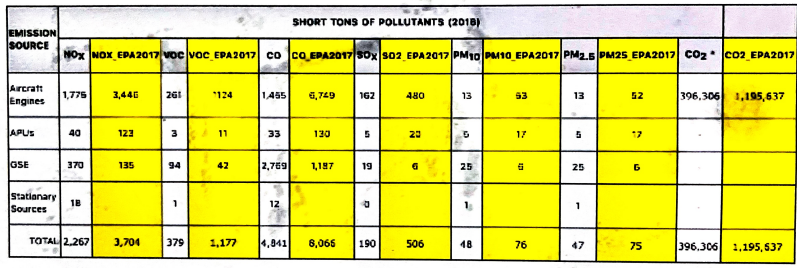
The SAMP’s air quality analysis compounds the problem by presenting numbers that do not survive contact with reality. The industry claims roughly 5,000 tons per year of criteria and toxic emissions.
But an EPA document from 2017, when operations were lower, put the figure at 11,000 tons. That is not a rounding error.
This is not new either. The emission totals have changed very little from the third runway EIS, where EPA stopped that expansion temporarily due to Clean Air Act violations. How can you more than double the emissions and now have no problems?
The models behind those numbers assume idealized conditions: new engines at peak efficiency, emissions dispersing evenly, engine emission data input that is much lower than it should be, and no accounting for the low-thrust landing plume that actually blankets the area.
When the input is wrong, every downstream conclusion is wrong, and the community is told the risk is acceptable when it is not.

A Risk Assessment Built on a Faulty Baseline
The risk assessment is equally untrustworthy. It considered only a narrow slice of the hundreds of compounds in jet exhaust, including carcinogens, formaldehyde, acetaldehyde, naphthalene, PAH, acrolein, and ultrafine particulates.
Worse, a 1993 air monitoring study found benzene in the neighborhoods at levels 120 times higher than the figure used in the airport’s current risk assessment. Both benzene and formaldehyde monitored levels were 50 and 60 times above the state source regulation.
Acrolein was the worst of all: measured levels were orders of magnitude above the state’s threshold for new sources of air pollution.
If the baseline was off by two orders of magnitude, every conclusion built on it - the cancer risk, the acceptable thresholds, all of it - is fiction.
A Regulatory System That Leaves Communities Unprotected
None of this would be tolerated from a factory. A smokestack would require scrubbers, permits, and continuous monitoring under state source regulation.
Airplanes are exempt from that framework. Nationally, they are covered only by new-engine emission testing under idealized conditions, published by the International Civil Aviation Organization (ICAO) with no consideration for thousands of dirty or aging engines operating daily at a single site.
The Clean Air Act is the only real lever, but it requires either an admission of violation from the industry or high-quality air monitoring. The industry will not confess, and the monitors sit far from the airport, measuring background air rather than the plume.
There is no synthesis, no source attribution, just local readings that tell the community nothing about what is actually in their lungs.
The Community Is Living With the Consequences
This is not a dispute over modeling assumptions. It is a documented pattern of understatement, narrow framing, and regulatory evasion, sustained over decades, while the people closest to the airport get sicker.
The SAMP is not a plan for sustainability. It is a plan to expand an operation that is already violating the intention, spirit and, likely, the letter of the Clean Air Act — and to do it on the backs of communities that were never given honest numbers, never offered real mitigation, and never asked whether they consented to the risk. It is egregious.
The airport is next door. The question is whether anyone in power will finally look at the numbers the community has been living with all along.
Debi Wagner
Community Advocate, University of Washington MOV-UP Advisory, Quiet Skies Puget Sound, Quiet Skies Coalition
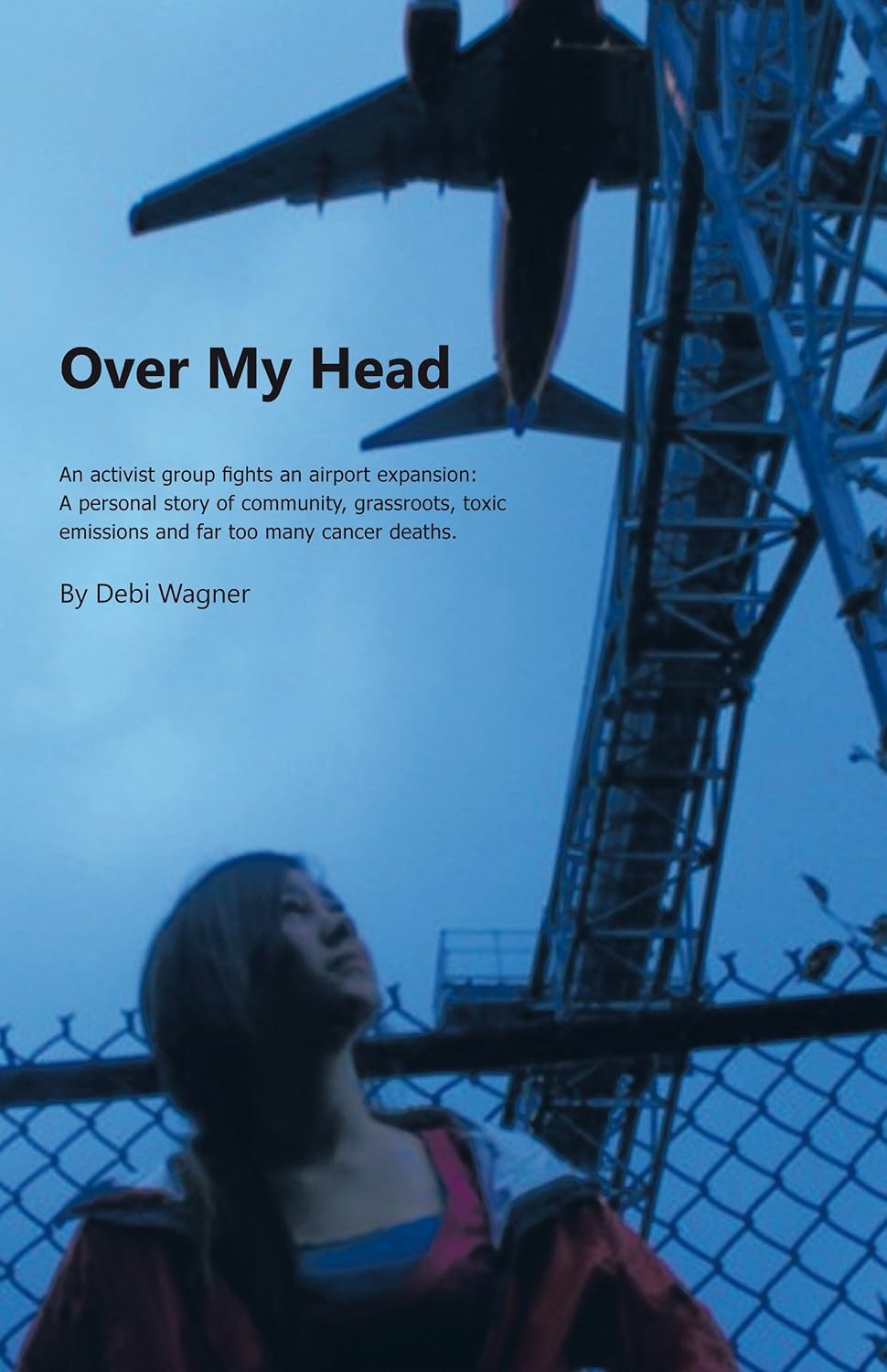
Debi Wagner became a community advocate in the early 1990s after her neighborhood was impacted by a busy flight path near Sea-Tac Airport. A vocal opponent of the airport’s third runway, she led a large grassroots organization and later served as administrative director of the Regional Commission on Airport Affairs, providing news and information to 34,000 residents. She also authored Over My Head, documenting the nearly 15-year fight against the runway.
For nearly 30 years, Wagner has worked to understand the effects of aviation emissions on public health, community well-being and the environment. A former city council member, she has collaborated with researchers, legislators and community groups to advance scientific research, environmental justice and changes in legislation. She has served for seven years on the advisory board for the University of Washington MOV-UP studies and previously served on the King County Climate Task Force.
AmazonDebi Wagner (Author) Format: Kindle Edition
Editor’s note: This guest opinion reflects the views of the author and does not necessarily represent the views of The Highline Journal.
Highline Journal Comment Guidelines
We believe thoughtful conversation helps communities flourish. We welcome respectful, on-topic comments that engage ideas, not individuals. Personal attacks, harassment, hateful comments, directed profanity, false claims, spam, or sharing private information aren't allowed. Comments aren't edited and may be removed if they violate these guidelines.