Education

For many years, the word “more” has preceded the phrase “technology in schools...” but growing research and parent concern are now challenging the assumption that increased screen time benefits students.
During the pandemic, devices such as Chromebooks, tablets and computers were deployed for remote learning. So were many related software and hardware tools. But even before the Covid closures, there was an ever-increasing push to use more and more technology during the school day. And certainly post - Covid, there’s been a constant push for screens, with online books replacing printed books, online testing, and more.
Three stories worth noting:
School Districts Starting to Dump Endless Tech
The first is the decision by Los Angeles Unified School District to require screen time limits, to eliminate all devices for students in Kindergarten and First Grade, block any screen time during lunch and recess for all K8 students, and to restrict the use of Youtube due to ads and the Autoplay feature. This story got national attention from NBC and the Today Show, as well as extensive coverage in education publications. One of the articles noted:
“Under the policy, which must be approved by June, schools will be encouraged to use laptop carts or computer labs for grades 2-5 and move away from 1:1 device use. LAUSD families will also be able to opt into using district-issued devices at home.”
Related is an article from the New York Times, reprinted in the Seattle Times on April 30, that discusses LA, New York, Oregon, and elsewhere, including perspectives from the United Nations:
“This year, two United Nations agencies, UNICEF and UNESCO, issued online learning guidelines warning that public schools had largely ceded digital education to private tech companies.
“Online learning tools had introduced important innovations,” the U.N. agencies said. But they also warned that digital learning platforms could treat schoolchildren “like consumers,” expose students to health, safety and privacy risks; and threaten school “autonomy.” Instead, “public needs and public purposes must steer” digital learning, UNESCO and UNICEF recommended.
This is a massive change for LA Unified. They were a national leader in deploying technology, though 12 years ago they had paused adoption because of a major contract-favoritism scandal.
Parents and Teachers Concerned About Negative Impact
The second story was an article in the Seattle Times about the April 22nd Seattle School Board meeting. Reporter Claire Bryan writes:
“The largest share of public comments Wednesday came from parents concerned about what their children can do on district devices, including watching YouTube videos, playing games, searching harmful content, watching pornography, talking to strangers and using Artificial Intelligence to write their essays.
“ ‘Children do not need EdTech products to be successful in the future,’ said Emily Cherkin, an educator, advocate and SPS parent, using the colloquial term to refer to educational technology. ‘The best preparation for a digital future is an analog childhood and an education built on people, paper and pencils.’
“Parents demanded more transparency around what their child is actually doing on the devices they use at school and what data they are consenting to share with companies when students use district devices. They also voiced concerns that safety features installed on student laptops for schools disappear once students bring the laptops home.”
The story adds that there’s a group of parents circulating a petition. The hope is for limits on educational technology, screen time in classes and a ban on cell phones during the school day. The petition is quite detailed, but this section stands out:
“Internet access on classroom devices can fragment students' attention, making it difficult for them to think deeply and stay on task. Indeed, numerous studies have shown better comprehension and retention when students learn on paper versus on screens. Classroom devices also create new behavioral challenges for teachers, requiring them to police online activity instead of teaching.”
The Seattle Times reporter also wrote about links between behavior issues in school and screen time:
“Experts have linked excessive screen time to academic, physical and emotional harm, including anxiety and depression, executive function disorders, eye disorders, sleep loss, neck pain and screen addiction.”
With Test Scores Dropping, is More Tech "always the way to go?"
The third article I read was published on March 10 by Jared Cooney Horvath, Ph D, M. Ed, who publishes The Digital Delusion: a “Substack investigating the real-world impact of educational technology on children’s learning and development.” It cuts against conventional wisdom that “more technology is always the way to go.”
I began exchanging emails with Highline School District communications to ask if the district was evaluating any of the issues raised by the author. Then the district announced they were going to ask the school board to run a technology levy in November, at the same time as the capital facilities bond. I then began asking some additional questions related to the tech levy.
I’m told the answers to those questions are “in process.” They are complicated and will likely be at least one full story.
More Screens, Lower Scores? Tech Spending Faces Scrutiny as Highline Eyes More Funding
The Highline School District is considering renewing a capital technology levy of about $12 million per year for four years to maintain and expand school technology systems. The proposed levy is expected to appear alongside a school replacement bond in November 2026. If approved, it would add about $180 per
 Staff Writer
So in the meantime while we wait for those answers, I want to summarize the March 10 Horvath article, and also bring in some other background information. (The intent as always is to inform parents and the community about facts so they can make informed decisions about ballot measures and also about what is going on in the classroom so they can take whatever actions they feel are appropriate.)
The title of Mr. Cooney’s article gives readers a very good sense of his main point:
When Correlation Repeats Across 50 States: The NAEP Evidence Behind My Senate Testimony
When states started adding technology, test scores started dropping...
His point is very simple: when states started adding technology, test scores started dropping. He points out that states deployed technology at different times through a staggered policy adoption, it is possible to see different results at different times. His starting point is test scores from NAEP, the National Assessment of Educational Progress, which has been given since 1992 using the same scoring system. He writes:
“Across state after state, scores in both 4th and 8th grade rose steadily for many years prior to large-scale digital adoption. After adoption, however, the trajectory shifts - often sharply - toward decline.”
Moreover, the decline is greater in 8th grade, when the students have had more tech than in 4th grade. The original story has graphs showing the steep drop. (Here they are)
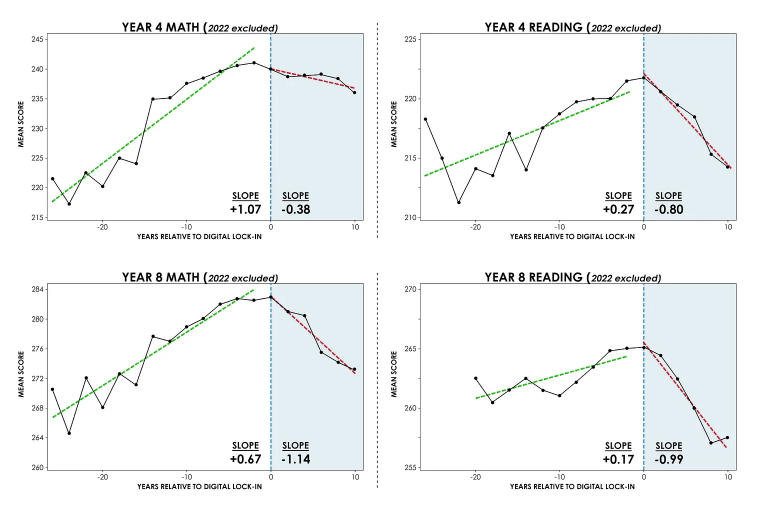
He adds that this is an international problem, and the relationship of more tech and lower scores occurs on many tests, not just the NAEP.
“Across international assessments (PISA, TIMMS, PIRLS), and across national testing (NAEP), the same pattern appears again and again.”
Perhaps the quote that most indicts ed tech is this one:
“And notably, there is no robust, internationally consistent signal suggesting that routine classroom digital exposure systematically improves learning outcomes. To be fair, there are isolated positive findings - but they do not replicate across contexts with the strength, scale, or consistency of the negative association.”
By ‘technology,’ he does not mean just one-to-one devices. Rather, he “examines broader, statewide digital adoption.” This adoption pre-dates Covid. His data set excludes 2022 NAEP data, which was the most impacted by Covid. His data table shows 2015 as the pivotal year for Washington state.
Closing Thoughts
There are a wide range of perspectives on technology in schools. I am regularly seeing ads for Devlearn, a conference in Las Vegas this fall where the All Access pass for three days currently costs $2,845, a discount from the regular price of $3,495.
The web sites of Google, Microsoft (introducing AI for schools, among their many initiatives), Apple and curriculum publishers all have many claims about the value of technology in schools. Again, the goal of this story is to provide background for questions being asked of the Highline School District, questions that were asked before the tech levy was announced but that take on more importance when the preliminary cost estimate is roughly $650 per student per year for each of the four years of the levy.
Members Discussion
Highline Journal Comment Guidelines
We believe thoughtful conversation helps communities flourish. We welcome respectful, on-topic comments that engage ideas, not individuals. Personal attacks, harassment, hateful comments, directed profanity, false claims, spam, or sharing private information aren't allowed. Comments aren't edited and may be removed if they violate these guidelines.