Educational Resources

Important and Helpful Links and Forms:
💡Declaration of Intent to Provide Home-Based Instruction
💡Washington Parent and Student Opt-Out Notice Form -Template
💡Highline School District Sexual Health Opt-Out Form
💡Comprehensive Sexual Health Curriculum - OSPI Standards
As families prepare for a new school year, our checklist should include more than backpacks, supplies and schedules. Parents should also know what their children are being asked to participate in, what they are being taught, and when they have the right to say no.
For families in Highline Public Schools, that starts with paying attention to surveys and screeners and important Opt-Out Forms that need to be turned into your school.
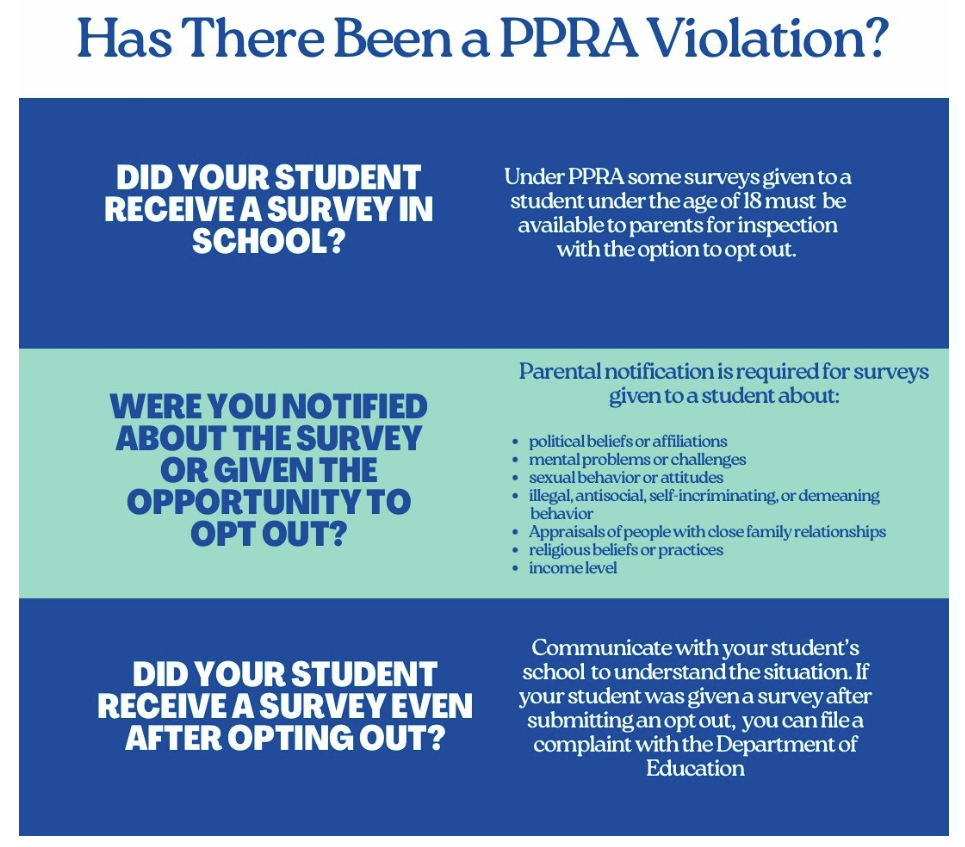
Highline uses programs including Panorama surveys that asks sensitive and personal information and SBIRT — Screening, Brief Intervention and Referral to Treatment. SBIRT can include the "Check Yourself" questionnaire and potential follow-up based on a student's answers that might raise red flags. These aren’t always shared with the parents. Parents should carefully review notices regarding these programs and the Healthy Youth Survey and exercise available opt-out or nonparticipation options when they do not want their children participating.
Don't assume every activity offered during the school day is mandatory. Ask questions, put opt-out requests in writing and keep copies.
Protection Pupil Rights Amendment
Sexual Health: Know What Your Opt-Out Covers
Washington law provides parents an important protection regarding comprehensive sexual health education.
Under RCW 28A.300.475, parents may review the Comprehensive Sexual Health Curriculum (start at page 35) and submit a written request excusing their child from any planned instruction in comprehensive sexual health education. The school must grant that request.
But parents should understand an important distinction.
Washington has also enacted laws governing inclusive instructional materials. RCW 28A.345.130 requires school-board instructional-material policies to provide for inclusive curricula and materials "representing historically marginalized and underrepresented groups, expressly including LGBTQ people."
HB 2331, enacted in 2024, also restricts school boards from rejecting or banning instructional materials simply because they include or discuss the roles and contributions of people belonging to protected classes. Washington's nondiscrimination statute includes sexual orientation, gender expression and gender identity among those protected classes.
This distinction matters.
Material involving sexual orientation or gender identity may appear in literature, social studies, classroom books or other everyday instruction rather than in a class labeled "sexual health."
Some parents may view that material as involving the same sexuality, identity, moral or religious issues that motivated their sexual-health opt-out. Legally, however, not every lesson involving sexual orientation or gender identity is automatically classified as comprehensive sexual health education. Therefore, Washington's sexual-health opt-out should not be assumed to cover every such classroom lesson.
Interestingly, Washington's sexual-health statute itself says it does not express legislative intent to require comprehensive sexual-health education — or its components — to be integrated into unrelated subjects.
Parents should therefore ask schools directly: Will any components of comprehensive sexual-health education appear in other subjects, and will my opt-out be honored there?
The Supreme Court Changed the Conversation
The U.S. Supreme Court's 2025 decision in Mahmoud v. Taylor is especially important because the case wasn't about a traditional sex-ed class.
It involved LGBTQ+-inclusive storybooks incorporated into elementary-school instruction. Parents with religious objections sought to excuse their children, and the school district stopped permitting opt-outs.
The Supreme Court ruled that imposing the instruction without an opportunity for an opt-out unconstitutionally burdened the parents' religious exercise. The Court emphasized that the parents weren't seeking authority to control the curriculum itself; they wanted their children excused from a particular educational requirement burdening their religious upbringing.
That doesn't create an unlimited constitutional right to opt out of anything a parent dislikes. But for families with sincere religious objections, Mahmoud is extremely significant — particularly when sensitive material appears in ordinary classroom instruction rather than a designated sexual-health course.
Why Washington's Parental-Rights Initiative Matters
This makes Washington's parental-rights debate particularly timely.
Initiative IL26-001, "Restoring the Parents' Bill of Rights," seeks to reinstate provisions concerning parents' access to instructional materials and school records, notification regarding certain services, and specified opt-out rights. The Secretary of State certified the initiative after signature verification in January.
Parents should understand that Washington already provides a specific statutory opt-out for comprehensive sexual-health education. The larger debate is about how broad and explicit parental rights to information, notification, records and opt-outs should be in state law, particularly as sensitive subjects can arise outside traditional health classes, and your rights to request and see those records as protected by FERPA laws.
Read the actual initiative and the official voters' pamphlet information before casting your ballot. The 2026 Washington general election is November 3.
Don’t Dismiss The Option To Homeschool
For some families, these concerns may lead to a bigger question: Is public school still the right choice for us?
Homeschooling doesn't have to mean educating alone. South King County and the greater Seattle area have homeschool co-ops, enrichment classes, field trips, social groups, faith-based communities and secular homeschool networks.
If you choose independent home-based instruction, remember to file a Declaration of Intent to Provide Home-Based Instruction. Washington's statutory annual deadline is September 15.
Make Parental Involvement Part of Back-to-School Preparation
Before school starts:
Read survey and screening notices. Review curriculum. Ask where or how sensitive subjects will be taught. Submit opt-outs in writing. If your objection is religious, communicate that clearly rather than assuming a general sex-ed opt-out covers it. Keep copies of everything.
Whether you choose public school, private school or homeschooling, being informed is one of the most important things a parent can do.
Know what your child is being taught. Know what information is being collected. Know your current rights — and pay attention when Washington voters are being asked to decide what those rights should be in the future.
Resources
For current policies, forms and procedures, families can consult:
Highline Public Schools' homeschool information
Highline's SBIRT information and FAQ
Washington OSPI's Home-Based Instruction information
Washington Homeschool Organization's South King County resource listings
Members Discussion
Highline Journal Comment Guidelines
We believe thoughtful conversation helps communities flourish. We welcome respectful, on-topic comments that engage ideas, not individuals. Personal attacks, harassment, hateful comments, directed profanity, false claims, spam, or sharing private information aren't allowed. Comments aren't edited and may be removed if they violate these guidelines.