Port of Seattle
Updated 6:39pm 8/27/26 to include City of Burien post link.
Seattle-Tacoma International Airport (Sea-Tac) is planning for significant growth through its Sustainable Airport Master Plan, commonly called the SAMP.
Before the Port of Seattle can move forward with 31 Near-Term Projects at Sea-Tac Airport, it must examine how those projects could affect people, neighborhoods and the environment. That examination was released this spring as a more than 6,000-page Draft Environmental Impact Statement.
The public had 90 days (originally set to 60 days) to review the documents and submit comments. Residents, schools, environmental organizations, community groups and local governments responded.
Among the most extensive submissions was a 187-page joint comment letter from Burien, SeaTac and Des Moines. The three airport-area cities argue that the draft minimizes some impacts, leaves out important information, and relies on inadequate or outdated analysis.
Their central concern is straightforward: Airport growth cannot be considered sustainable if its human, environmental, and financial costs are shifted onto surrounding communities.
What Readers Need to Know...
SAMP: The Port’s Sustainable Airport Master Plan.
SEPA: State Environmental Policy Act, requires agencies to identify and evaluate environmental impacts before making decisions.
What the airport proposes: 31 Near-Term Projects (NTP) intended to accommodate airport growth.
What the airport released: A Draft Environmental Impact Statement, or DEIS, totaling more than 6,000 pages.
What just happened: The 90-day formal public-comment period ended.
What the cities submitted: A 187-page joint response from the cities of Burien, SeaTac and Des Moines.
What happens next: The airport reviews the comments and responds through the Final Environmental Impact Statement (FEIS).
When: The Port has not announced a publication date for the final document.
SAMP: The Port’s Sustainable Airport Master Plan.
SEPA: State Environmental Policy Act, requires agencies to identify and evaluate environmental impacts before making decisions.
What the airport proposes: 31 Near-Term Projects (NTP) intended to accommodate airport growth.
What the airport released: A Draft Environmental Impact Statement, or DEIS, totaling more than 6,000 pages.
What just happened: The 90-day formal public-comment period ended.
What the cities submitted: A 187-page joint response from the cities of Burien, SeaTac and Des Moines.
What happens next: The airport reviews the comments and responds through the Final Environmental Impact Statement (FEIS).
When: The Port has not announced a publication date for the final document.
What did Cities of Burien, Des Moines, and SeaTac request?
The cities’ 187-page submission is highly technical. The concerns can be grouped into several areas. Together, they question whether the draft fully accounts for what airport expansion could mean for public health, air quality, noise, traffic, housing, schools, and the environment.
Below are some of the most important points I found in the letter. This summary combines direct quotations from the cities’ submission with my own observations and explanations. Quoted material appears italicized and in quotation marks.
Key Findings from the Cities’ Letter
The central concern
- The Port minimizes or completely ignores the impacts of its operations and expansion plans. I think this is the single most important point in the entire letter:
“Despite this documented burden, the DEIS systematically minimizes impacts to these communities across every major resource category. As set forth in detail below, the DEIS must be corrected to address material deficiencies that prevent it from providing the ‘reasonably thorough discussion’ of environmental impacts that SEPA requires. Residents Opposed to Kittitas Turbines v. State Energy Facility Site Evaluation Council, 165 Wn.2d 275, 312, 197 P.3d 1153 (2008).”
Missing data and misleading baselines
- The letter discusses the extreme complexity of analyzing the 6000 pages, especially when the Port did not include underlying data. From the cities’ letter:
“Third, the Port failed to include in the publicly available DEIS record (or timely provide the Cities with) the underlying data, modeling inputs and outputs, key analytical documentation, and finalized regulatory determinations upon which many of the DEIS's conclusions depend — making complete review within 60 days structurally impossible.” - The baselines and comparisons use outdated, incomplete starting points, which can result in misleading or understated conclusions.
For example, flight track sample data used as a starting point is from only eight months in 2022. There is no explanation of why flights from June, August, November, and December were excluded from the data sample. Note that air traffic in 2022 was still depressed due to COVID.
Obsolete science and outdated models
- The Port uses obsolete science, not current research on human health. There are dozens of examples. Here is one:
“The DEIS for the SAMP Near-Term Projects fails this standard in multiple material respects. Across aviation forecasting, air quality modeling, transportation analysis, noise health effects, biological resources, and greenhouse gas accounting, the Port has relied on outdated data sources, superseded model versions, stale calibration baselines, and older scientific references where demonstrably superior current alternatives were available. These are not minor technical footnotes. Each gap is capable of skewing significance conclusions in ways that systematically understate impacts on communities that already score 9 or 10 on Washington's Environmental Health Disparities Index.”
Air pollution
- When planes emit pollution during landing and takeoff operations, where does it go?
The airport uses national generalization, not specific to Sea-Tac, to evaluate what happens to airport pollution in the atmosphere.
The cities are confused as to why the port is using a model created in 1972 for what happens when airplane emissions and the atmosphere interact. The model is based on all mixing occurring at the 3,084 feet. Data from Quilayute (Olympic Peninsula) plays a key role in the projections for Sea-Tac, even though there are marked differences between Quilayute, with 100 inches of rain per year, strong ocean winds, and other differences, compared to our area.
Noise impacts
- Thousands more residents will be in the expanded 65 dNL noise contour, yet the airport claims “No Significant Impact.”
The letter also notes the Draft EIS contradicts the current Part 150 study about ways to address airport noise:
“The exposure counts in the DEIS are not the only current estimates in the record. The draft Part 150 materials report 6,915 housing units and 18,410 people within the 2022 65 DNL contour, compared with the DEIS figures of 6,216 housing units and 14,061 people. For 2032, the draft Part 150 materials report approximately 10.2 square miles, 9,941 housing units, and 26,302 people within the 65 DNL contour. The FEIS should reconcile these datasets, identify their respective source years and methods, and explain which figures control the significance and mitigation analyses.”
There is considerably more to this quote on page 20; if you’re concerned about airport noise, page 20 is well worth reading. - The airport Draft EIS ignores current research about noise impacts, including landmark studies from the World Health Organization
- The cities argue that the DEIS does not report potentially meaningful noise increases below the 65 DNL (Day/Night average sound Level) threshold.
According to the cities’ letter, FAA Order 1050.1F establishes "reportable change" thresholds—including a 3 dB increase in the 60–65 DNL band and a 5 dB increase in the 45–60 DNL band—that apply even where the overall significance threshold is not exceeded. The DEIS does not demonstrate whether any modeled scenario produces reportable changes in these sub-threshold bands, leaving a compliance gap.
Water, wildlife, and Puget Sound
- The airport mischaracterizes an evaluation of the project done by the National Marine Fisheries Service (NMFS) that is included in the EIS
“Its findings — incorporated into the DEIS record through the Biological Evaluation and related materials — are significantly more alarming than the DEIS's chapter-level narrative suggests”
The letter then outlines the impacts of “PCBs, PBDEs, and PFCs, petroleum hydrocarbons (PAHs), tire-derived pollutants such as 6PPD-quinone, metals” and more on whales, fish, marine life, and Puget Sound health that are not addressed in the draft EIS. See pages 38 - 42 and 44 - 49. - Impacts on Miller, Walker, and Des Moines creeks, the impacts of tire residue composed of 6PPD-Quinone.
The rebuttal section entitled “An Emerging Contaminant of Acute Concern” shows how pollutants are not properly assessed.
.
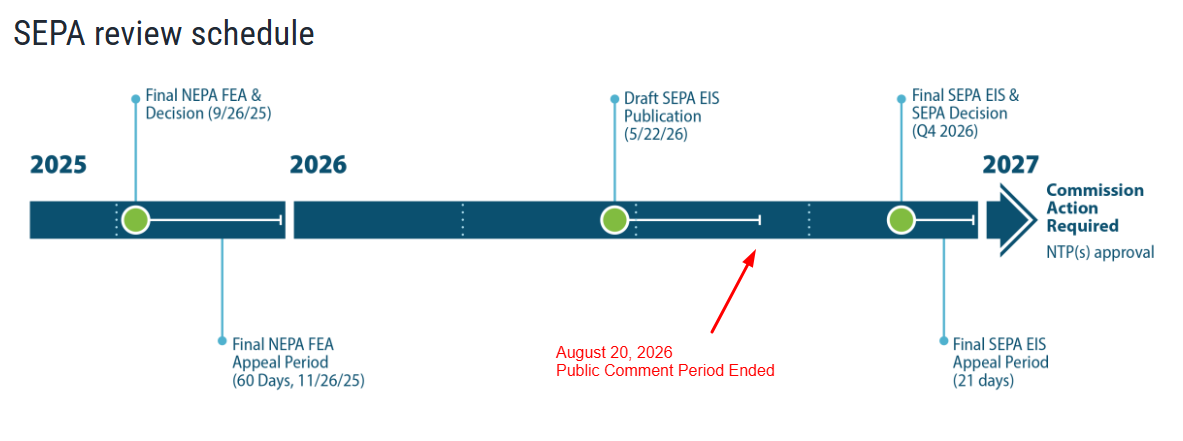
SEPA review schedule for SAMP. Image from www.sea-samp.com Port of Seattle
What Happens Next
The Port of Seattle must now review the submissions it received and respond to the comments through the Final Environmental Impact Statement. No publication date has been announced.
The cities’ 187-page submission gives the Port a detailed list of questions to answer. The next test will be whether the Final Environmental Impact Statement corrects the identified shortcomings, provides the missing analysis and establishes protections that extend beyond the airport property line.
SEA SAMP | Sustainable Airport Master Plan
This site contains all environmental review materials for the Port of Seattle’s Sustainable Airport Master Plan Near-Term Projects.
 shendersonmaulfoster.com
Although the formal comment period has ended, residents may still contact Port commissioners, attend public meetings and continue raising concerns about the airport plan. Those communications may not become part of the official DEIS comment record, but the public-policy conversation is not over.
Complete Letter from Sea-Tac Airport Adjacent Cities
UPDATE: At the time of publication, the letter was not available on the cities’ websites.
As of Thursday Aug 27, the City of Burien has also posted the letter: https://www.burienwa.gov/news_events/city_newsroom/news_announcements/burien_des_moines_seatac_airport_deis_comment
Members Discussion
Highline Journal Comment Guidelines
We believe thoughtful conversation helps communities flourish. We welcome respectful, on-topic comments that engage ideas, not individuals. Personal attacks, harassment, hateful comments, directed profanity, false claims, spam, or sharing private information aren't allowed. Comments aren't edited and may be removed if they violate these guidelines.