Elections
Highline voters will decide Nov. 3 whether to approve a $595.4 million construction bond.
The largest projects are Sylvester, Cascade and Chinook Middle Schools. The proposal also includes CHOICE Academy modernization at Southern Heights and $40 million for districtwide critical needs.
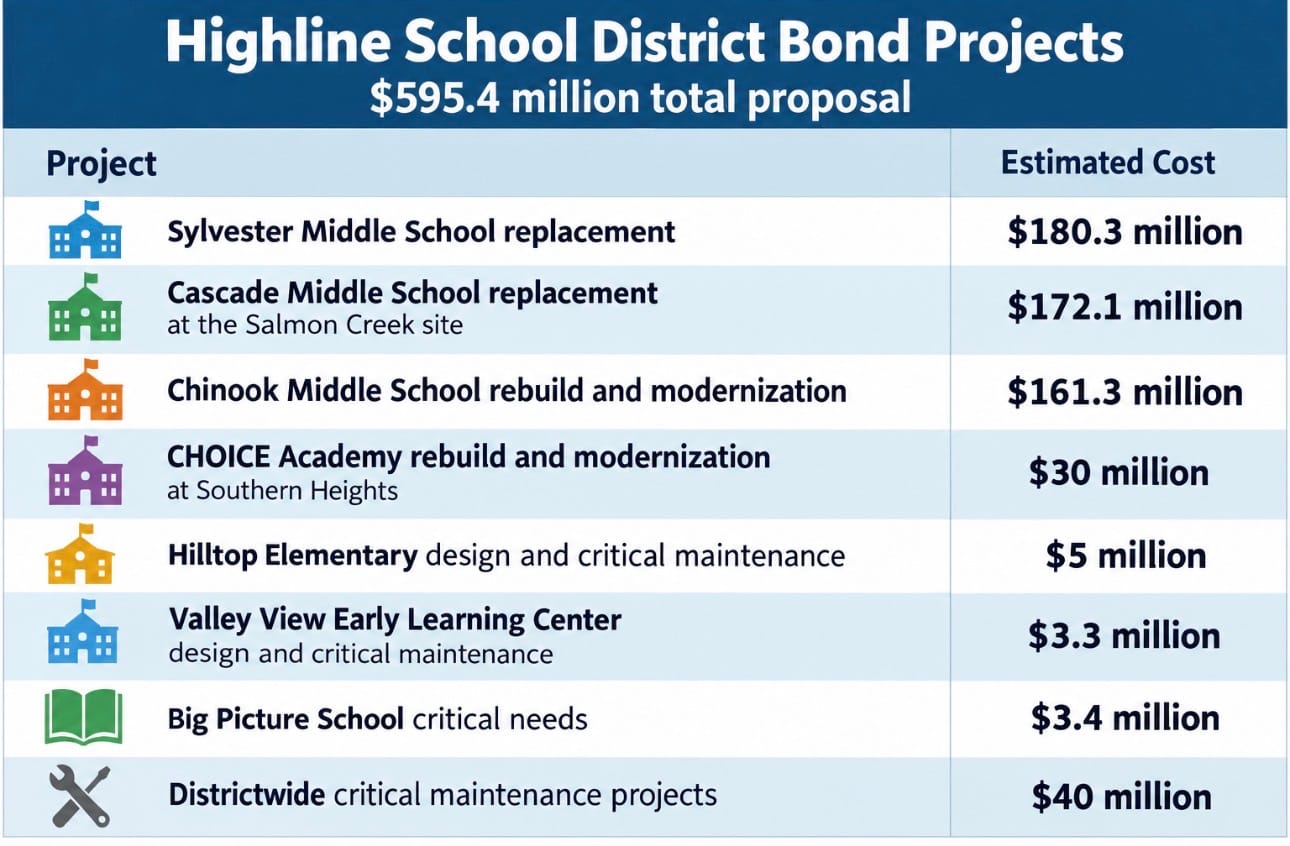
The bond is separate from Highline’s $48 million technology levy, that will also be on the ballot.
What Does Your Vote Mean?
YES: Approves the $595.4 million bond and authorizes Highline to borrow money for the proposed plan, affecting property taxes.
NO: Rejects the $595.4 million bond. Highline would not be authorized to borrow money for the proposed plan. The district could run a revised ballot measure in the Spring.
YES: Approves the $595.4 million bond and authorizes Highline to borrow money for the proposed plan, affecting property taxes.
NO: Rejects the $595.4 million bond. Highline would not be authorized to borrow money for the proposed plan. The district could run a revised ballot measure in the Spring.
The bond requires 60% voter approval or it does not pass.
Highline’s Capital Facilities Advisory Committee (CFAC) spent two years reviewing school building needs and helping develop the bond proposal. Its membership includes community volunteers selected by lottery as well as appointed representatives.
Here are four questions at the center of the debate.
1. Why is Highline asking voters to fund Cascade relocation before the Salmon Creek site is fully studied?
SUPPORTERS SAY
Cascade needs replacement, and moving it to Salmon Creek site allows Highline to build without constructing a new school around students attending the existing Cascade campus. CFAC ultimately recommended Salmon Creek, saying it would save taxpayers $44 million.
OPPOSITION SAYS
Opponents say more research should be completed before voters authorize $172.1 million for the project. They are concerned about the plan to relocate Cascade from its current location near Evergreen High School to the former 6.5 acre elementary school site at Salmon Creek.
They want answers about traffic, property size, whether additional land may be needed, and the overall feasibility and cost of the site.
They also ask: What happens to the money if Salmon Creek does not work?
WHAT WE FOUND
The bond resolution gives the School Board flexibility if circumstances change. Under specified conditions, the Board can change projects or redirect bond proceeds.
That means approving the bond does not necessarily lock Cascade into Salmon Creek if the project cannot proceed there as planned.
2. Why approve $161.3 million for Chinook now if construction won’t begin until 2031?
SUPPORTERS SAY
Chinook is aging and needs substantial work. Supporters say including it now keeps all three comprehensive middle schools moving forward. They also say delaying the project could increase construction costs and leave students in an aging building longer.
OPPOSITION SAYS
Opponents question authorizing $161.3 million now when construction is not expected to begin until 2031.
They also question whether Highline has adequately compared the long-term cost of a partial rebuild and modernization with replacing Chinook entirely.
They recommend a bond package that scales back to include only Chinook design and planning, making it “shovel ready” for the next bond.
Others are asking if the district is overbuilding for the amount of expected students. For example, Tyee HS was built for 1100 yet less than 700 currently attend.
WHAT WE FOUND
CFAC considered delaying Chinook, but it was added at the last moment. Smaller packages were developed that left the major Chinook construction for a future bond. CFAC ultimately chose to include the $161.3 million partial rebuild and modernization in this proposal.
3. How much can Highline change the plan after voters approve $595.4 million?
SUPPORTERS SAY
Supporters say a construction program spanning many years needs flexibility. Costs, site conditions, and other circumstances can change after voters approve a bond.
OPPOSITION SAYS
Opponents argue voters should have stronger assurances that money approved for specific projects will be spent on those projects.
They point to the bond resolution’s provisions allowing the Board to change plans or redirect money under certain circumstances. They also question the $40 million for “Critical Needs,” which is not divided into a fixed list of individually priced projects.
WHAT WE FOUND
The bond resolution does give the Board flexibility if circumstances change and provides a process for redirecting bond proceeds.
The $40 million Critical Needs category is similarly broad. Highline identifies types of work that could be funded, such as roofs, HVAC, plumbing, electrical systems, and other building needs, rather than providing a fixed $40 million project-by-project budget.
In short, voters are approving a $595.4 million capital plan with some flexibility, not eight project accounts that can never change.
4. Could Highline move schools forward with a smaller bond?
SUPPORTERS SAY
The majority of CFAC supported a bond package including all three comprehensive middle schools. Supporters say delaying projects could increase construction costs and leave students in aging buildings longer.
OPPOSITION SAYS
Opponents argue Highline could move forward with needed construction and plan for future projects while asking taxpayers for less now.
They favor completing the most urgent projects first and returning to voters later for additional construction, and reporting back to the public on how they did with those funds.
WHAT WE FOUND
Smaller packages were considered.
CFAC developed potential packages at $450 million, $500 million, $550 million, and $650 million. In a February preference exercise, the $500 million option received slightly more member preferences than any other amount.
CFAC ultimately recommended a $615.4 million package, with 21 members supporting it and three opposed. The three dissenting members favored moving construction forward with a smaller package.
The proposal was later reduced by $20 million. In a subsequent digital poll, 21 of 24 CFAC members supported the changes, resulting in the final $595.4 million recommendation.
The smaller options show that the choice was not simply between moving forward with construction or doing nothing. CFAC considered different ways to move projects forward at different costs.
What happens if the bond fails?
If the bond does not receive the required 60% approval, Highline cannot borrow the proposed $595.4 million, and the projects would not move forward as currently planned.
The district could revise the plan and return to voters with another bond proposal, including a smaller or differently structured package.
A NO vote does not cancel the projects. It rejects this $595.4 million bond proposal and requires Highline to prioritize what comes next.
Read More About It Here:
2026 Bond & Tech Levy | Yes for Highline
Capital Facilities Advisory Committee - Highline Public Schools
This is part of The Highline Journal’s ballot measure series, examining the measures voters will see on the November ballot, what supporters and opponents say, and what the measures would actually do.
LOOKING FOR CLARITY? SAVE THE DATE
Community Conversations: Ballot Issues
Tuesday, October 6 | 6:15–7:30 p.m.
RSVP for location: highlinegoodneighbors@gmail.com

Members Discussion
Highline Journal Comment Guidelines
We believe thoughtful conversation helps communities flourish. We welcome respectful, on-topic comments that engage ideas, not individuals. Personal attacks, harassment, hateful comments, directed profanity, false claims, spam, or sharing private information aren't allowed. Comments aren't edited and may be removed if they violate these guidelines.