Education

It doesn't take much to see that the educational landscape across the nation has been shifting the last 5-10 years. Parents are waking up to find that their children are not being challenged enough, are not performing well or reading to the same caliber or skills that they might have 25-30 years ago.
And while many parents are taking a hands-on approach and getting more involved, showing up to meetings and asking more questions, the public schools pretended to not notice or care... until they couldn't ignore it anymore.
According to a Seattle Times article, What WA Public Schools Are Doing About Declining Enrollment by Denisa R. Superville, (published Jan 20, 2026), Washington schools have not seen an enrollment climb as some predicted since the pandemic, in fact, they have seen a sharper downturn, which is leading districts to growing budget shortfalls and having to make major cuts to teachers and classrooms.
While the article cites "declining birthrates," as the main reason, it also acknowledges that since the pandemic, many students who left public education for other learning opportunities and environments, did not come back like they expected. However, charter, online, private schools and homeschool have seen steady rates and growth over the same period.
The Seattle Times spoke with Thomas S. Dee, a professor in the Graduate School of Education at Stanford University, who has studied K-12 enrollment and absenteeism nationally. The article says that, "while declining birthrates are largely responsible for enrollment declines in Washington and across the country, the state’s K-12 loss is steeper than the drop in the school-age population," according to Dee. "That could be a signal that many families who left public schools in 2020 did not return," he said.
The article continues, "that if public schools want to attract more families they must focus on their core mission: quality academics." "The fact that so many schools aren’t teaching foundational literacy skills in evidence-aligned ways is really problematic," Dee said.
Current academic data is reported biannually to the Office of Superintendent of Public Instruction (OSPI) by public school districts, including our own Highline School District. These reports show a consistent decline in student performance in math, reading, and science. Fewer students are meeting grade-level standards, and many lack the reading and math proficiency needed to successfully transition from middle school into high school.
Despite these trends, students continue to graduate even when essential academic skills and knowledge have not been fully achieved, leaving them at a disadvantage compared to peers in other states. How have we come to accept this as an acceptable outcome for our students?
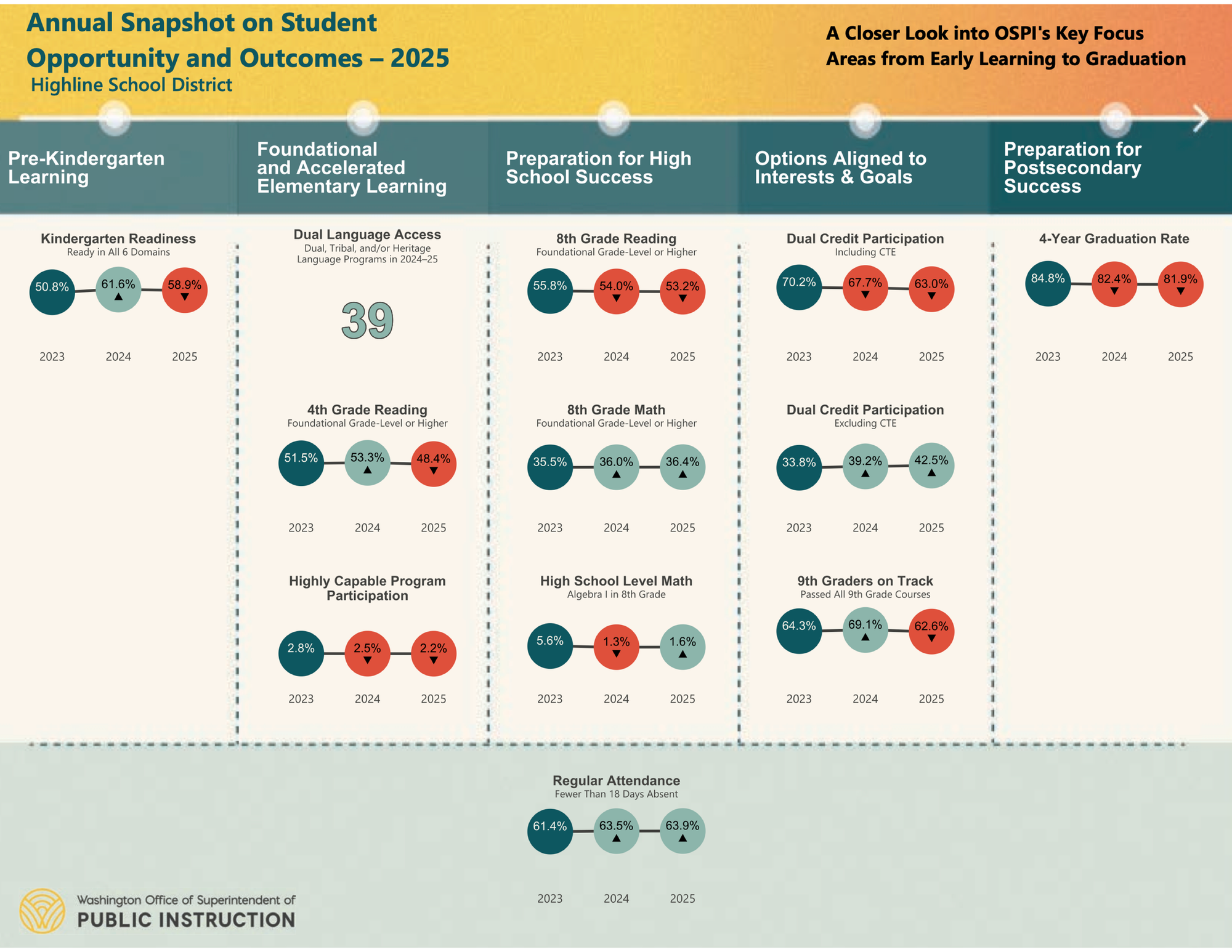
Many parents can attest to that and are continually looking for other pathways and educational opportunities to help their kids, but according to the ALEC index, Washington state isn't doing well when it comes to alternative pathways for students.
The Health and State of Washington Educational Opportunities Vs. The Nation
The 3rd edition of the 2026 ALEC INDEX OF STATE EDUCATION FREEDOM was just published by the American Legislative Exchange Council (ALEC), made up of the nation’s largest nonpartisan, voluntary membership organization of state legislators.
"The purpose of the Index is it "ranks each of the 50 states based on how well they provide different educational options to families. There are five categories that each state is assessed in: student-centered funding, charter schools, home schools, virtual schools, and open enrollment," according to the published guide.
Andrew Handel, Director, Education and Workforce Development Task Force for the American Legislative Exchange Council says, "the education freedom movement is...returning authority to parents and allowing them to choose the best school suited to their child’s needs."
When looking at all educational and academic opportunities and outcomes, Washington ranks 39th, behind Louisiana and Mississippi, with a D rating, according to the Index. Florida ranks #1 overall.
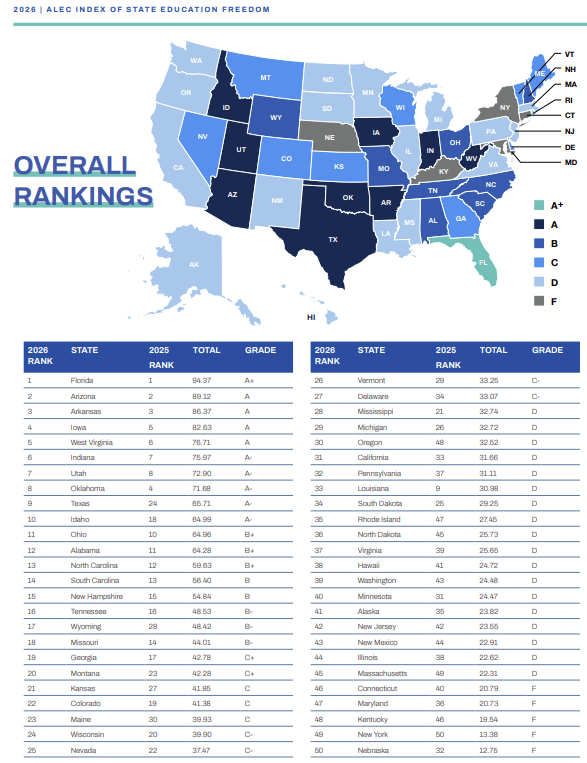
The rest of the Index charts and explanations of the categories are directly from the ALEC Index Guide and can be found in its entirety here.
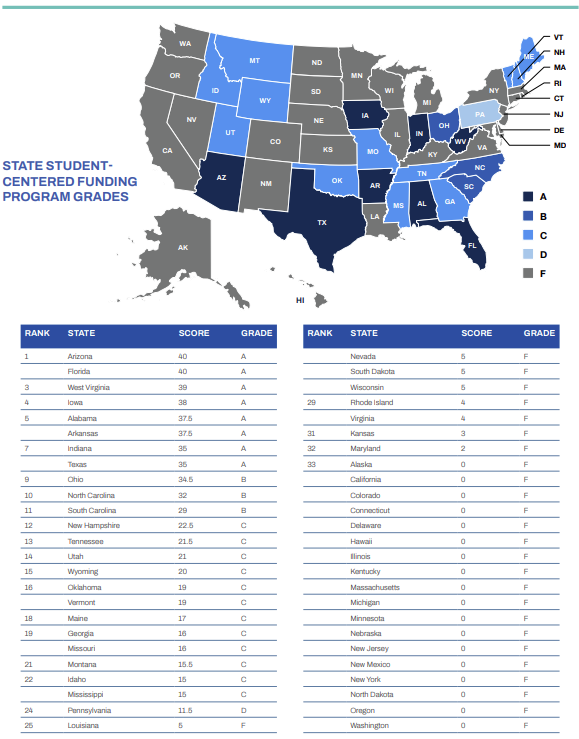
STUDENT-CENTERED FUNDING PROGRAMS
Washington State Rank #50, Grade F
Rather than simply allocating state education dollars to public schools based on enrollment figures, these programs allow dollars to follow a student to whatever learning environment is best for their needs. The gold-standard of student-centered funding programs is education scholarship accounts (ESAs). These programs place state education dollars into an account that parents can use to pay for a wide variety of approved education expenses. These expenses typically include tuition, standardized testing fees, school uniforms, textbooks, therapies for students with special needs, and more. Four states, including New Hampshire, Tennessee, Texas, and Wyoming, passed universal ESA programs in 2025. In total, 12 states have passed legislation to create a universal ESA program.
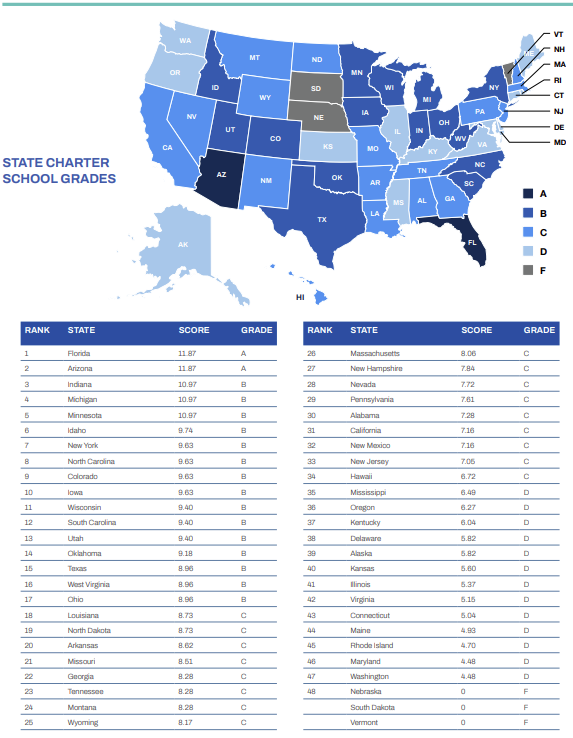
CHARTER SCHOOLS
Washington State Rank #47, Grade D
Charter schools are tuition-free public schools that operate without the regulations given to traditional public schools. In exchange for this freedom to innovate, charter schools commit to obtaining specific learning goals. So long as these goals are met, the charter school can continue to operate. A state earns top marks in this category when the growth of charters is not capped, when a universal and/or non-district authorizer is available, and when charter schools receive similar funding to their traditional public-school counterparts.
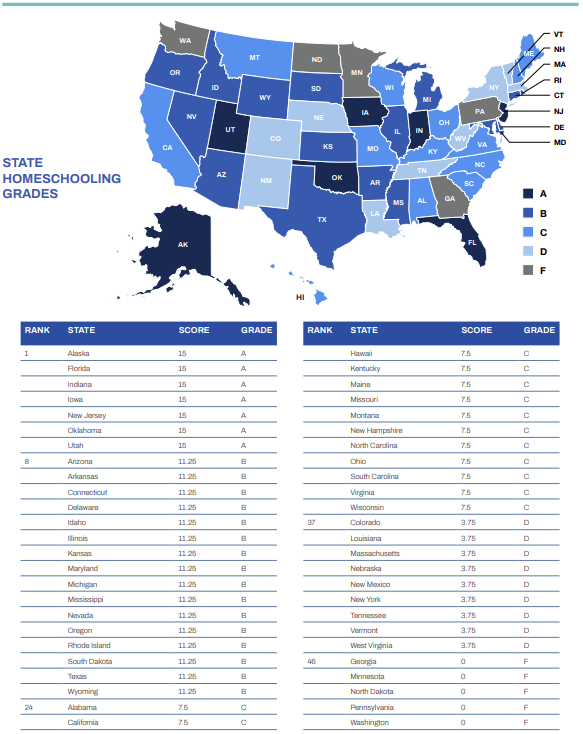
HOMESCHOOLING
Washington State Rank #50, Grade F
Homeschooling is perhaps the most customizable and tailored approach to learning for students. Thanks to its flexibility, homeschooled students receive a unique educational experience that is parent-led and primarily home-based. State laws should allow these parents maximum flexibility to teach their students in the best manner possible by minimizing burdensome regulations. States earn an “A” when parents are not required to notify their school district that they are homeschooling. In addition, regulations that can impede the homeschooling experience, like testing and academic requirements, are not present
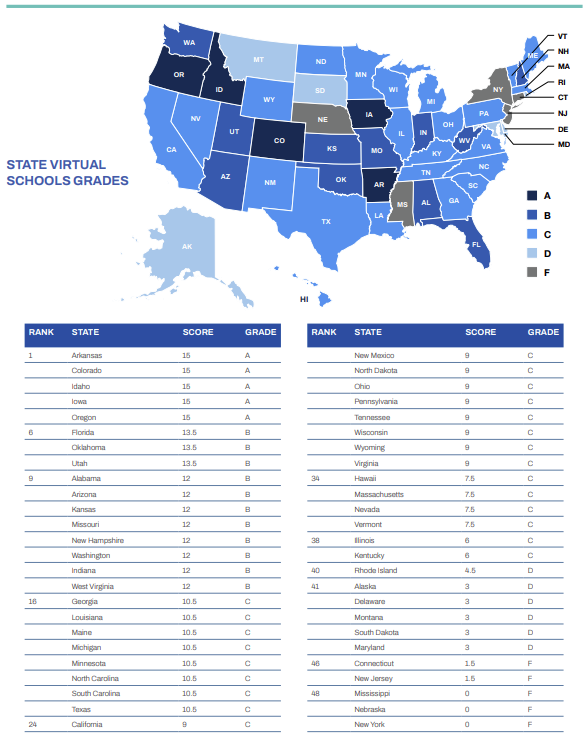
VIRTUAL SCHOOLS
Washington State Rank #14, Grade B
Virtual schools offer online classrooms where students receive instruction from teachers who are certified in online pedagogy. The software used in these virtual schools is tailored for an online learning environment. The best states for virtual schooling will have virtual options available to students statewide and across school districts. These states also ensure that virtual school students can take their state assessments virtually
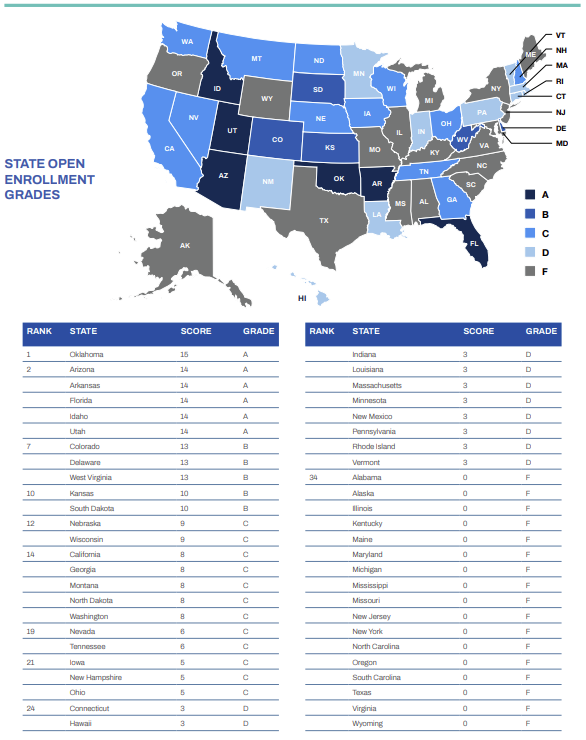
OPEN ENROLLMENT
Washington State Rank #14, Grade B
Open enrollment refers to policies that allow students to attend a traditional public school outside of their designated attendance zone. There are two types of open enrollment: interdistrict and intradistrict. Interdistrict open enrollment policies allow students to transfer to a traditional public school outside of their assigned school district. Intradistrict open enrollment policies allow students to transfer to another traditional public school outside of their attendance zone but still within the same school district. The best open enrollment policies permit both inter- and intradistrict open enrollment while mandating that school districts participate in these programs, subject only to reasonable limitations like classroom space.
Members Discussion
Highline Journal Comment Guidelines
We believe thoughtful conversation helps communities flourish. We welcome respectful, on-topic comments that engage ideas, not individuals. Personal attacks, harassment, hateful comments, directed profanity, false claims, spam, or sharing private information aren't allowed. Comments aren't edited and may be removed if they violate these guidelines.