Education

Closure reveals low enrollment, poor outcomes, and operational issues, challenging claims that funding limits alone drove Why Not You Academy’s decline.
Recently, the Highline Journal re-posted a story from the Washington Policy Center about charter schools in Washington state. The story was of local interest because it mentioned the Why Not You Academy high school in Des Moines. The charter school is closing at the end of the current school year, as decided in a board meeting in November 2025.
The Washington Policy Center story focused on fiscal challenges charters face and asserted that the lack of local levy money was a factor in why charter schools close, and implied that Why Not You was an example of this. The article also addressed waitlists and noted that there are many students who would like to enroll in charters but can’t get off waitlists.
But there is more to the story than just a lack of funding.
I became interested in Why Not You Academy in 2019, when I attended an open house led by the two school co-founders. At the time, the school was named Cascade Public School. It later changed names because of a major donation by former Seattle quarterback Russell Wilson.
Challenges of Starting a High School
The school has had major challenges right from the start. There’s more to the school closing than a lack of local levy dollars. There are some lessons to be learned that apply to all schools, not just charters. The school:
- Faced state corrective action in the 2023-24 school year, as reported in this article in the Seattle Times, in part because of low enrollment, leadership and teacher turnover, and other issues. KUOW linked to another Times’ story and had an interview with the original reporters. Issues also included non-certified teachers and students with disabilities not being served
- Delayed its original start because of Covid
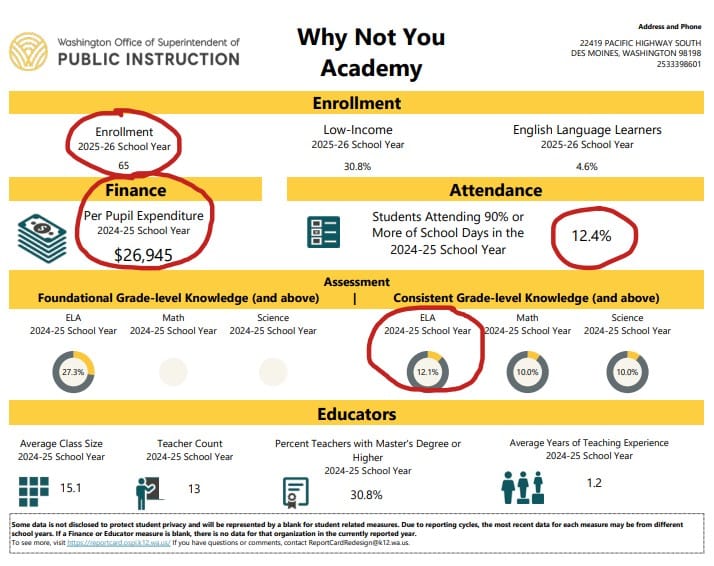
- Experienced poor attendance rates and low test scores, as reported on the OSPI web site:
- In the 2024-25 school year, just 12.4% of students attended 90% or more of school days.
- Only 10% of students taking the state math test in 10th grade and 12% of those taking the English test met the state standard, defined as a 3 or 4 on the Smarter Balanced test.
Comparison to nearby Highline High Schools
Highline has two high schools that are near the academy: Tyee HS and Mount Rainier HS.
By many metrics, Why Not You was no better, and in some cases worse, than the two nearby public schools Here are some comparisons for 10th grade test scores on the SBA:
- Attendance rate: both Highline schools are significantly better
- Tyee’s is four times higher with 48.5% attended 90% or more
- Mt Rainier is higher still, at 56.2%
- ELA (English scores): both schools are significantly better
- Tyee’s is three times higher: 31.2% achieved a 3 or 4 on the SBA
- Mt Rainier’s percent is 55.5%
- Math is mixed
- Tyee’s rate of 9.9% is nearly identical to Why Not You
- Mt Rainier has a much higher rate, at 26.6% achieving a 3 or 4
While these rates for Tyee and Mt Rainier are better than Why Not You, they still are far below state averages. ELA state average is 58.9%. Math is 30.8%. Tyee is far below these numbers. Mount Rainier is slightly below the state average on both tests.
Enrollment Realities
The initial enrollment in fall 2021, as reported in the OSPI data, was 102 students. The next year, the 10th grade class was listed as 86, so they lost 16 students. But the class entering 9th grade that year was much smaller, at 60.
This year, there are just 65 students enrolled.
In 2024-25, enrollment showed significant drops. There were just 48 students in grade 12. This is less than half the 102 who had started in 9th, and is a significant drop from the 78 juniors who had been enrolled the previous year. And even worse, there were just 15 students in 9th grade. The other grades also had significant drops from the previous year.
Spending Per Student
The state report card reveals that Why Not You spent $26,945 per student in the 2024-25 school year, significantly more than nearby Tyee or Mount Rainier high schools.
- Tyee averaged $24,175 per student, spending $2,775 less per student than WNY.
- Mount Rainier averaged only $18,330, so $8,645 less per student.
Idealism vs. Reality
When I attended the 2019 open house, I was very impressed by the idealism of the school founders. They had great goals. However, I walked out thinking “there are some wishes that seem pretty unlikely to happen.” An example: the hope was for all students to go off campus several times a year, maybe even once a week on early release Wednesday, to learn about jobs and careers. That’s a great idea, but the hope was for parents to drive the students in parent cars. That did not seem likely to happen, based on my experience of seeing how few parents are willing, able, and available to volunteer in schools.
Transportation is also a challenge for any start-up school. The location on Pacific Highway worked for some students, but for most, there was no direct bus, and the school was located in a commercial area, not a residential neighborhood with families who reside within walking distance.
What the Washington Policy Center also misses is that starting up a high school is a lot more difficult than for K-8 students. High schools require teachers with specific certifications, students are at a wide range of levels between 9th and 12th grades, and our state already has a choice program called Running Start, where high school students can enroll in community colleges for both college and trade preparation. When students can enroll in these options, their sending school gets a very modest payment. This is manageable for a large school, but for a small school, losing roughly $16,000 or more per student can be a big loss.
An example of the difficulty of innovating in high school is Maritime. The Seattle Times just ran a story about Maritime High School, noting in particular that enrollment is only about a quarter of the original goal of 400 students.
The bottom line is that innovation in education is very hard to implement. The closure of Why Not You points to the broader lesson that school innovation requires strong execution, sustainable enrollment, and realistic planning, not just new ideas or funding changes.
Members Discussion
Highline Journal Comment Guidelines
We believe thoughtful conversation helps communities flourish. We welcome respectful, on-topic comments that engage ideas, not individuals. Personal attacks, harassment, hateful comments, directed profanity, false claims, spam, or sharing private information aren't allowed. Comments aren't edited and may be removed if they violate these guidelines.