Government
This article is part of The Highline Journal’s 2026 Ballot Issues series examining statewide initiatives and local school measures.
Washington voters have rejected 10 consecutive income-tax proposals since 1934. The last, Initiative 1098 in 2010, failed 64% to 36%.
There is one wrinkle in that history. Washington voters approved an income tax in 1932 with 70% of the vote, but the Washington Supreme Court later struck it down. Every statewide personal or corporate income-tax proposal put before voters since then has failed.
But this year, voters aren’t being asked whether Washington should create an income tax.
The Legislature already did.
ESSB 6346 created a 9.9% tax on Washington taxable income above a $1 million standard deduction, beginning in 2028. The first returns and payments are due in 2029.
Initiative 645 asks voters whether to repeal that tax before collections begin and prohibit state and local governments from imposing individual income taxes in the future.
What Your Vote Means
YES: Repeal the new individual income tax and prohibit state and local individual income taxes.
NO: Keep the individual income tax, often referred to as the “Millionaires Tax,” in place.
YES: Repeal the new individual income tax and prohibit state and local individual income taxes.
NO: Keep the individual income tax, often referred to as the “Millionaires Tax,” in place.
There is plenty of campaign rhetoric surrounding I-645. The Highline Journal sifted through the claims and checked them against the law, legislative record and fiscal documents.
What People Are Saying
Could the $1 million income-tax threshold change?
Could the $1 million income-tax threshold change?
| SUPPORTERS SAY | OPPONENTS SAY | WHAT WE FOUND |
|---|---|---|
| Future lawmakers could lower the $1 million threshold, expanding the tax to more Washingtonians. | Gov. Bob Ferguson has pledged to veto an attempt to lower the threshold. The threshold also adjusts for inflation. | The threshold is currently $1 million. Future lawmakers could change the law. Whether they will is unknown. |
Does a YES vote remove the other tax breaks?
| SUPPORTERS SAY | OPPONENTS SAY | WHAT WE FOUND |
|---|---|---|
| I-645 repeals the income tax but leaves the other tax breaks passed with ESSB 6346 in place. | Losing the income-tax revenue could put those benefits and other spending under budget pressure. | I-645 itself does not repeal those tax breaks. |
How does the new income tax affect public employee pension exemptions?
| SUPPORTERS SAY | OPPONENTS SAY | WHAT WE FOUND |
|---|---|---|
| Lawmakers made existing public-pension exemptions inapplicable to the new income tax. | The $1 million deduction still applies, so pension income isn’t automatically taxed. | Both are true. Lawmakers also rejected an amendment that would have excluded public pensions from the income tax. |
Would a YES vote mean cuts to schools and children?
| SUPPORTERS SAY | OPPONENTS SAY | WHAT WE FOUND |
|---|---|---|
| I-645 does not directly cut K-12 schools, childcare or healthcare. Only 5% of the income-tax revenue is specifically earmarked for the Fair Start for Kids Account. | A YES vote would eliminate billions in projected revenue they say is needed for K-12 schools, childcare, healthcare, higher education and human services. | A YES vote eliminates the new revenue source but does not itself cut those programs. Five percent is earmarked for Fair Start for Kids; the rest goes to the general fund. |
The law directs 5% of the revenue to the Fair Start for Kids Account, which funds childcare and early learning. The remainder goes to the state general fund. The law directs that revenue toward the tax relief contained in the bill and public investments including K-12 education, healthcare, human services and higher education.
The state’s fiscal analysis estimates I-645 would reduce projected state revenue by about $11.4 billion over fiscal years 2027 through 2031. Because the income tax has not begun, this is projected future revenue, not money the state is currently collecting.
The Case for Keeping the Tax (NO)
Sen. Jamie Pedersen, D-Seattle, sponsored ESSB 6346 and describes it as a Millionaires Tax.
Opponents argue the tax is narrowly targeted at very high incomes and provides billions in additional revenue for schools, healthcare, childcare and other state priorities.
The Case for Repeal (YES)
Supporters argue the issue goes beyond who pays today. Washington now has an individual income tax, and future lawmakers could change the $1 million threshold.
I-645 would repeal the tax and prohibit state and local governments from imposing individual income taxes.
That brings voters back to a familiar debate, but with the question flipped.
This time, they’re deciding whether to keep an income tax the Legislature has already enacted.
Rep. Dan Griffey proposed an amendment to remove public pensions from the new income tax. Legislative staff described its effect as: “Excludes public pensions from being included as income for the purposes of the income tax.”
The amendment was not adopted.
That does not mean the typical retired teacher suddenly owes a 9.9% tax. The $1 million deduction still applies. Legislative reports confirm, however, that pension statutes were changed so pension income is not exempt from this particular tax.
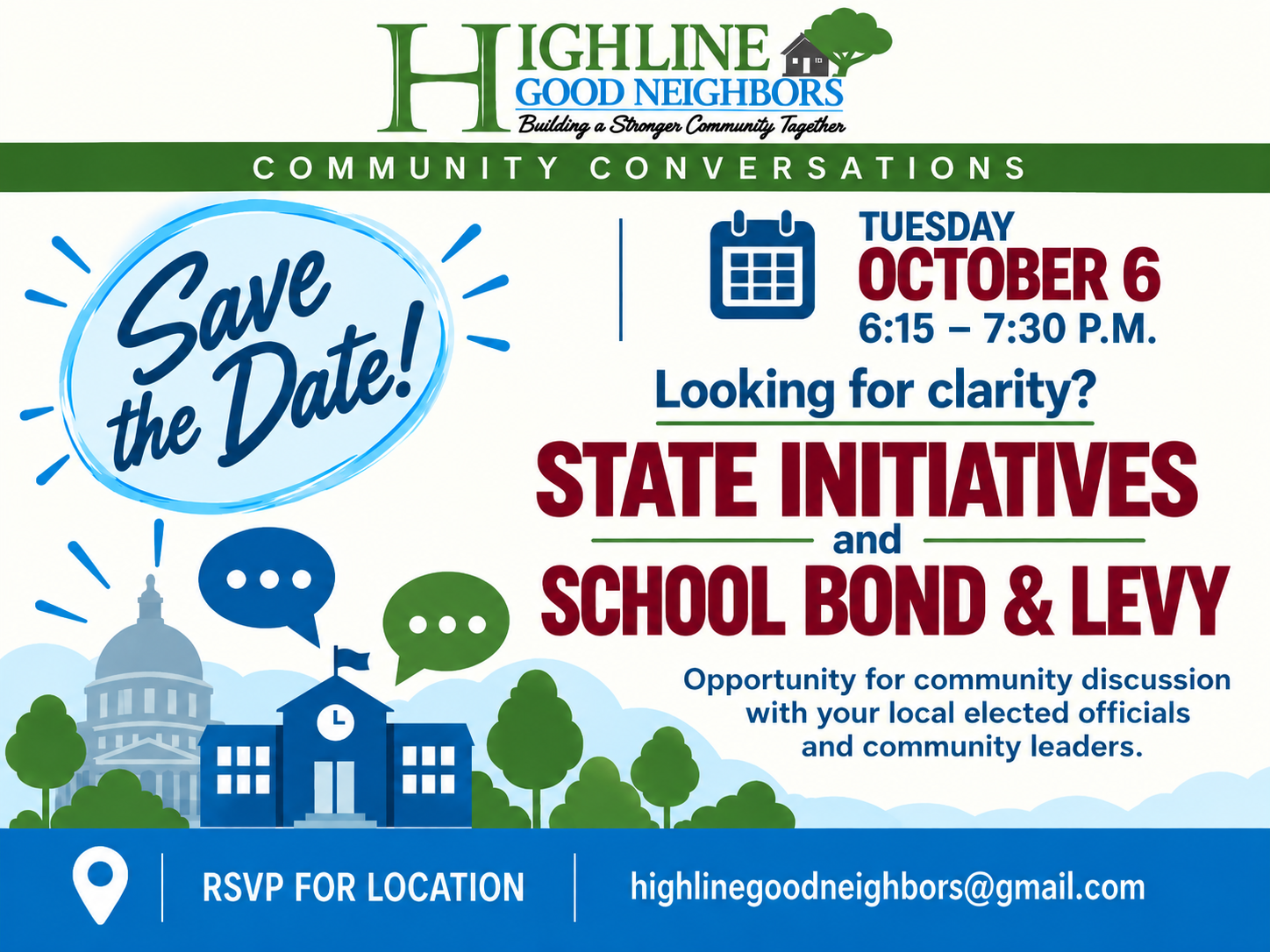
LOOKING FOR CLARITY? SAVE THE DATE
Community Conversations: Ballot Issues
Tuesday, October 6 | 6:15–7:30 p.m.
RSVP for location: highlinegoodneighbors@gmail.com
Highline Good Neighbors will host a community discussion about state initiatives and the Highline School District bond and levy, featuring local elected officials and community leaders and an opportunity for the public to ask questions.
This is part of a five-story Highline Journal series examining the three statewide initiatives and the Highline School District bond and technology levy. Each story will explain what the measure does, what YES and NO mean, and the principal arguments from supporters and opponents.
Members Discussion
Highline Journal Comment Guidelines
We believe thoughtful conversation helps communities flourish. We welcome respectful, on-topic comments that engage ideas, not individuals. Personal attacks, harassment, hateful comments, directed profanity, false claims, spam, or sharing private information aren't allowed. Comments aren't edited and may be removed if they violate these guidelines.