Education

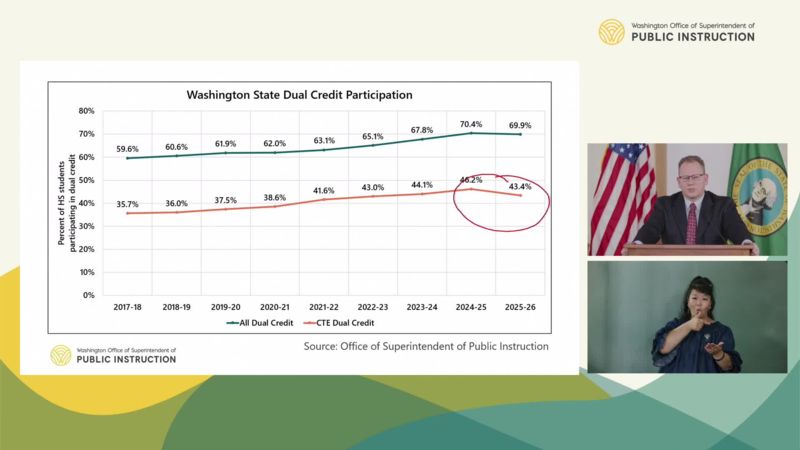
When Washington State Superintendent Chris Reykdal discussed stagnant student achievement in his Sept 10th press conference, his explanation pointed to poverty, economic disparities and what he argues as "inadequate funding for public schools."
Of course those factors deserve consideration, but they don't seem to hold water to what is happening in Mississippi, the second poorest state and one of the lower-funded spending per pupil, according to a Wall Street Journal article titled, “Mississippi Fixed Its Schools. Here’s How Other States Can Too.”
Reykdal and OSPI released their new student achievement data and previewed his 2027 budget priorities. Reykdal argued that Washington schools need additional resources. He also identified other challenges—including screen time, declining reading habits and attention spans.
OSPI Chris Reykdal Press Conference - TVW
Washington Superintendent of Public Instruction Chris Reykdal holds a press conference to release new student achievement data and preview 2027 budget

But there is an uncomfortable question that Washington’s education debate cannot avoid:
If more spending is a primary answer to combat poor academic performance, where are the results?
Washington has substantially doubled its spending in K–12 education over the past decade, and sits near the top of the nation in teacher salaries and spending per student. The situation is particularly striking locally in Highline Public Schools.
Last year we reported based on Highline’s budget information and statements from Chief Financial Officer Jackie Bryan, district spending was approximately $13,743 per student in 2018 and was projected to reach about $25,000 per student in the 2025–26 school year—an increase of roughly 82 percent in less than 10 years!
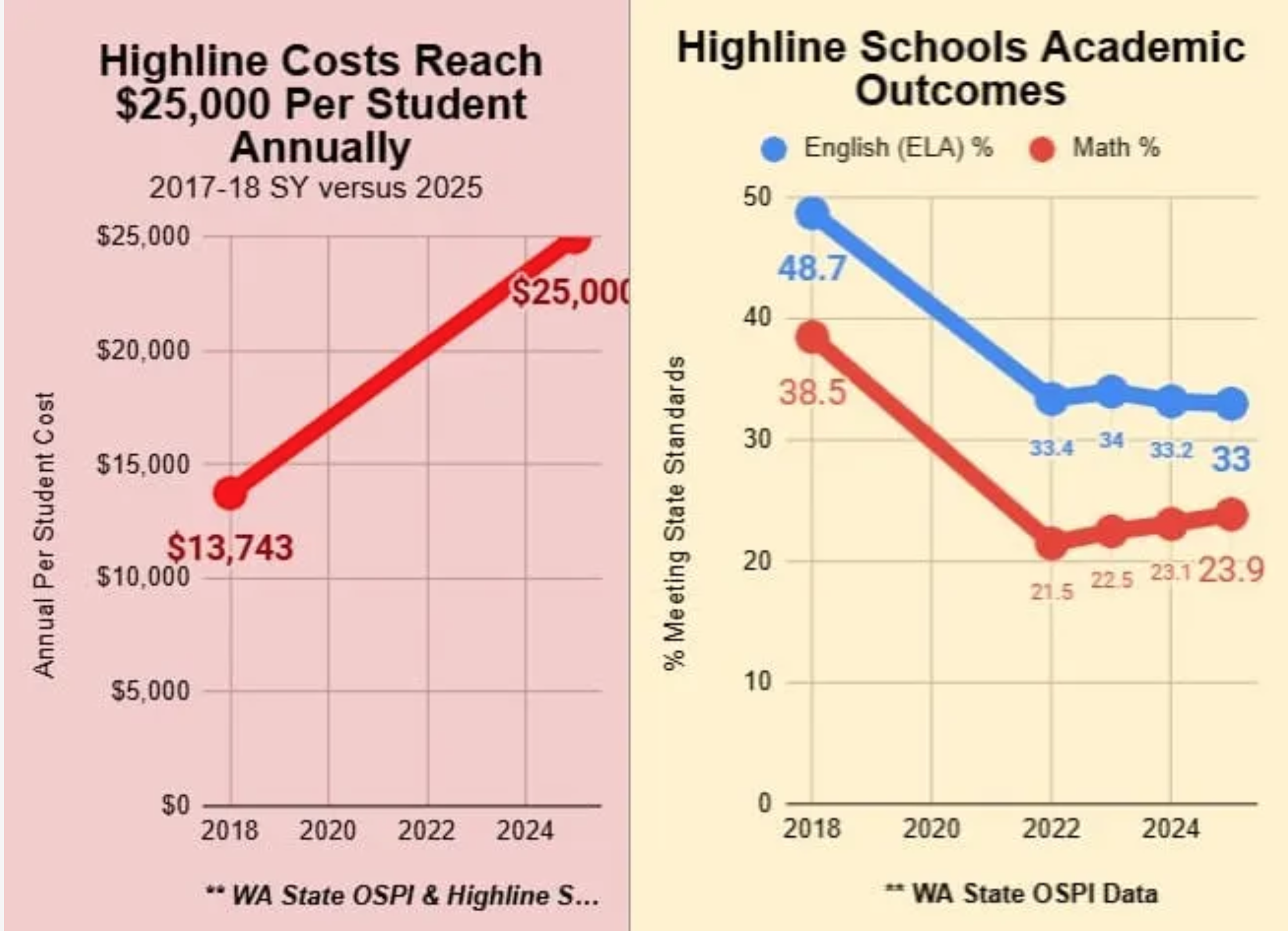
However, academic performance has moved in the opposite direction over that same period of time, and continues to decline.
In 2018, 48.7 percent of Highline students met state English Language Arts standards. By 2025, that number was 33 percent. Math proficiency fell from 38.5 percent to 23.9 percent. Those figures come from Washington OSPI assessment.
That does not mean spending caused the decline. COVID disruptions, student demographics and numerous other factors complicate any simple cause-and-effect conclusion.
But the numbers do challenge the premise that increasing funding, by itself, will solve Washington’s achievement problem.
Then there is Mississippi.
In the September 10 Wall Street Journal article, Rachel Canter describes how Mississippi pursued a sustained package of literacy reforms beginning with its 2013 Literacy-Based Promotion Act. The reforms included systematic phonics, screening young students for reading difficulties, teacher training and coaching, notifying parents when children fall behind, and intervention—including retention requirements in some circumstances—for struggling third-grade readers.
The results are difficult to dismiss
Federal NAEP data show Mississippi fourth graders scored 219 in reading in 2024, compared with 214 for public-school students nationally.
The Journal reports that Mississippi went from being tied for last nationally to the national average in fourth-grade reading and math by 2019. By 2024, its fourth graders tied for seventh among states in reading and 13th in math, without adjusting for demographics.
And Mississippi did it while remaining one of America's lowest-spending states.
According to the U.S. Census Bureau, Mississippi spent $12,324 per pupil in FY2024, making it the fifth-lowest. The national average was $17,619. (Census cautions that these figures are not adjusted for inflation or regional cost-of-living differences.)
It does demonstrate that high poverty and relatively low spending do not make major academic improvement impossible.
That is where Washington's education conversation needs to pivot.
When achievement disappoints, the first question cannot always be how much additional money the system needs. It must also be what schools are teaching, how they are teaching it, how quickly struggling students are identified, whether interventions work, and whether the billions already being spent are producing measurable academic improvement first!
The Price of Big Promises: Highline’s Billion-Dollar Plans Signal a Texas-Style School Funding Crisis
Texas school debt offers a cautionary tale as Highline voters weigh new bonds and levies, raising questions about debt, spending, and academic results.
 Melissa Petrini
But are teachers being pressured to move away from these proven programs and methods? The Journal also points to "Powerful teachers’ unions" as an "obstacle to reform."
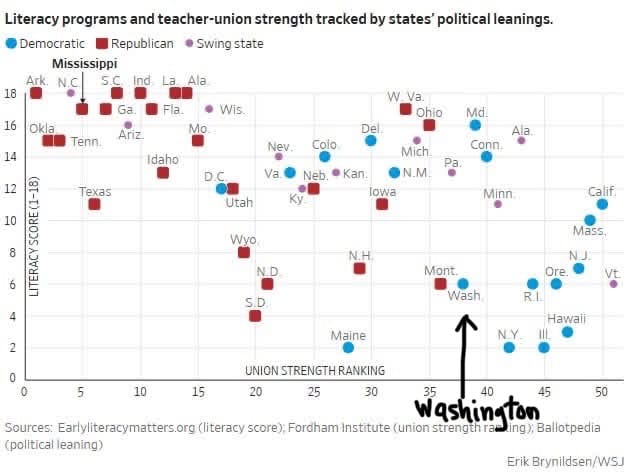
So is it a money problem or a priority and power-struggle problem?
Before taxpayers are asked to accept "increased funding" as a central explanation for disappointing outcomes, they deserve an equally serious discussion about educational instruction and agendas, proven programs & curriculum and meaningful measurable results.
Many voters are beginning to examine the educational outcome ROI (Return on Investment). Will this stark realization of change voter sentiment and voting patterns?
Sources & Links:
Chris Reykdal — full September 10, 2026 press conference:
Watch Reykdal's full statement on TVW. TVW identifies the event as Reykdal's press conference releasing new student achievement data and previewing his 2027 budget priorities.
Wall Street Journal — September 10, 2026:
“Mississippi Fixed Its Schools. Here’s How Other States Can Too.” by Rachel Canter. The piece describes Mississippi's literacy reforms and their relationship to the state's subsequent achievement gains.
Federal NAEP results:
National Center for Education Statistics — Mississippi Grade 4 Reading, 2024. NCES reports Mississippi's fourth-grade average reading score at 219 versus 214 nationally.
Federal school-finance data:
U.S. Census Bureau — FY2024 Public School Spending. Census reports Mississippi current spending of $12,324 per pupil and specifically notes that its statistics are not adjusted for geographic cost-of-living differences.
Members Discussion
Highline Journal Comment Guidelines
We believe thoughtful conversation helps communities flourish. We welcome respectful, on-topic comments that engage ideas, not individuals. Personal attacks, harassment, hateful comments, directed profanity, false claims, spam, or sharing private information aren't allowed. Comments aren't edited and may be removed if they violate these guidelines.