Education
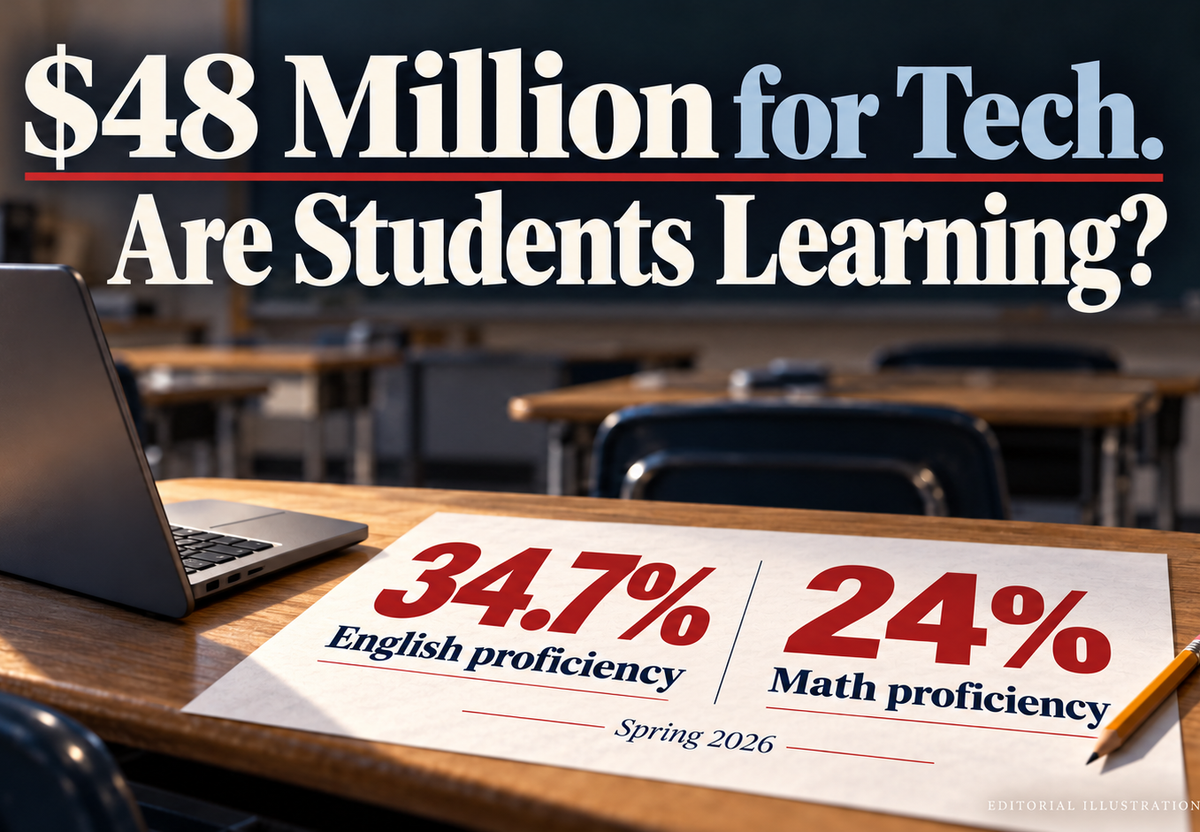
Districts nationwide are reducing tech. Highline test scores are at an all-time low. How is technology making Highline students better?
Over the past few months, I’ve been asking questions about the Highline School District Technology Levy that is on the November 3 ballot. I hope this Q&A can help voters make an informed decision.
Is tech in education helping students learn?
Answer:
Highline test scores from spring 2026 show 34.7% of students demonstrate “consistent grade-level knowledge” on English and 24% do so on math (this is a 3 or 4 on the SBA assessment). This news story is the first public reporting of these scores. We will write a more complete story later.
Much of the justification for technology in education is “it will help students learn.” Claims of learning are hard to evaluate. But if we look at test scores, the answer is “no, this technology is not effective.”
The scores are much lower than in the 2018-19 school year, the last year before COVID and also a time when there was much less tech in education. Here’s the contrast:
- English: 48.7, which is 14.0% higher than the 34.7% in spring 2026.
- Math: 35.7%, which is 11.7% higher than the 24.0% in spring 2026.
The 2025-26 scores are also lower than 2021-22. See the state report card for more information.
How is the district evaluating tech in education when many districts nationwide are changing course? Are our children just subjects to education experiments?
Answer:
There has never been a Highline school board work study session on technology in education, with topics such as goals, spending, effectiveness, and ways to mitigate risks. At best, there’s been minimal parent input.
Highline leaders in the past 20 years have never said anything similar to Seattle Superintendent Shuldiner, who recently stated:
“There's no reason why a kindergarten kid needs to have an iPad every day in their hand,” Shuldiner said. “That just doesn't make any sense to me. People learned way before iPads were invented.”
Seattle is making major shifts. So is Los Angeles: as noted in this story, LAUSD is banning screens for K1 and setting stringent limits for grades 2-12.
These are not outliers: nationwide, there is a significant backlash against tech. For example, Fortune magazine, in a story about how the Gates Foundation is going to spend $400 million on funding AI in education (often using Microsoft technologies), wrote:
"Test scores have dropped among some students over the same time period since computer assessments were widely implemented. Meanwhile, research shows that ever since the U.S. spent $30 billion to swap textbooks for laptops, Gen Z has shown to be less cognitively capable than previous generations, according to written testimony by neuroscientist Jared Cooney Horvath presented to the U.S. Senate Committee on Commerce earlier this year.
“'Evidence indicates that indiscriminate digital expansion has weakened learning environments rather than strengthened them,' he wrote.
The article goes on to note:
"However, a Gates Foundation spokesperson told Fortune its approach is built around those very concerns. The spokesperson said the tools will be tested in schools serving high shares of low-income students, paired with teacher training, and evaluated by independent researchers before being scaled. Plus, the foundation’s own strategy warns 'too many tools have been adopted without evidence they work' and insists teachers 'remain central.'"
Seeing that the tools will be “tested” in low-income schools is chilling when one thinks of announcements of AI being tested in Highline through Microsoft’s Elevate initiative.
For more information about Highline's guidelines, read Highline’s approaches to AI.
What is the situation with screens in Highline?
Answer:
Screen time use begins in kindergarten with each student getting their own device. Starting in sixth grade, students are able to bring home their devices. Screen time is up to individual teachers and school-level administrators.
Parents I’ve talked with say there’s a wide range of use. In some cases, it appears students are assigned screen time so teachers can free up time to deal with children who need extra help for academics or behavior.
What is the cost of the tech levy?
Answer:
This levy is a fixed dollar amount of $12 million per year. At 36 cents per thousand estimated for the first year, the cost is $36 per $100,000 of assessed value.
So, a property assessed at $600,000 would pay $216 per year. A $900,000 property would pay $324. Assessed value and rates can change, but bottom line is over four years, these home owners would pay $864 and $1,296, respectively.
Where does the money go?
Answer:
The initial plan for the first year is covered in this story. In future years, the allocation is up to the board to approve.
The board resolution does not specify dollar amounts, just categories. It gives the board a lot of flexibility, and much of the spending could be on items that at best are support for technology that one would expect to be in a capital funds budget or even operations.
The ballot measure and the voter information summarize at a higher level how the money can be spent.
I asked specific questions about replacement cycles and device costs. Here’s the answer from the district's Chief Communications Officer Tove Tupper:
“Highline tracks technology assets through its ticketing and asset management system, including the lifecycle of equipment. Replacement cycles vary by type. Classroom technology is generally on a four-year lifecycle, student and staff devices on a four- to six-year lifecycle, and technology infrastructure typically has a lifespan of five years or more, depending on the equipment.
“Student devices include several types of equipment depending on the instructional program. Approximate current costs range from $433–550 for Chromebooks and $378–440 for iPads to $1,700–2,100 for Windows devices. Device purchases also vary significantly from year to year based on replacement needs and available funding.”
If you have specific questions about technology in Highline, we suggest contacting the school district at the levy information page.
RELATED:
Highline’s $48 Million Technology Levy: Four Questions at the Center of the Debate
Is another $48 million for technology the answer? Highline voters face questions about screens, cybersecurity, student achievement, and spending priorities.
 Katie Kresly

Members Discussion
Highline Journal Comment Guidelines
We believe thoughtful conversation helps communities flourish. We welcome respectful, on-topic comments that engage ideas, not individuals. Personal attacks, harassment, hateful comments, directed profanity, false claims, spam, or sharing private information aren't allowed. Comments aren't edited and may be removed if they violate these guidelines.