Education

The Highline School District is considering renewing a capital technology levy of about $12 million per year for four years to maintain and expand school technology systems.
The proposed levy is expected to appear alongside a school replacement bond in November 2026. If approved, it would add about $180 per year for a $500,000 home (0.36 per thousand), creating a four-year taxpayer commitment—following a major levy increase in November 2025 and ahead of another bond measure.
District officials say local levies have long funded these systems. CFO, Jackie Bryan, noted the previous levy was approved during COVID to provide devices, and the district states, “Voters have supported a technology levy in the past to fund essential school infrastructure.” They also emphasize that “school districts across Washington rely on local levies to maintain operations,” while Board Legislative Liaison Stephanie Tidholm said she hopes “the state will fulfill their paramount duty to fully fund education.”
At the same time, research is raising questions about whether more classroom technology actually improves learning or maybe hindering it.
What National Testing Data Shows
Neuroscientist Jared Cooney Horvath analyzed National Assessment of Educational Progress (NAEP) data, which has tracked U.S. performance since 1992. He found a consistent pattern:
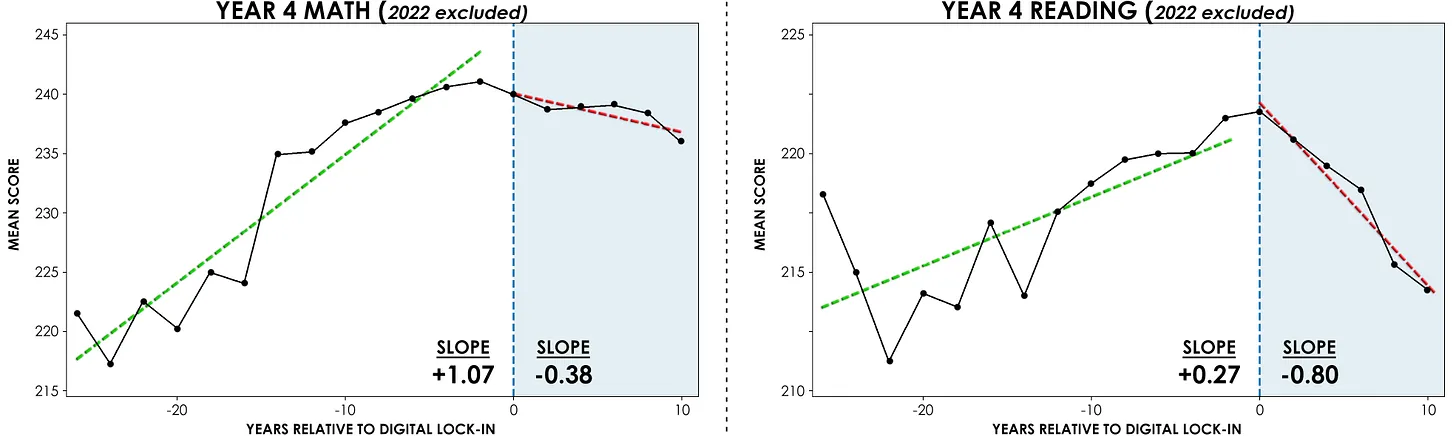
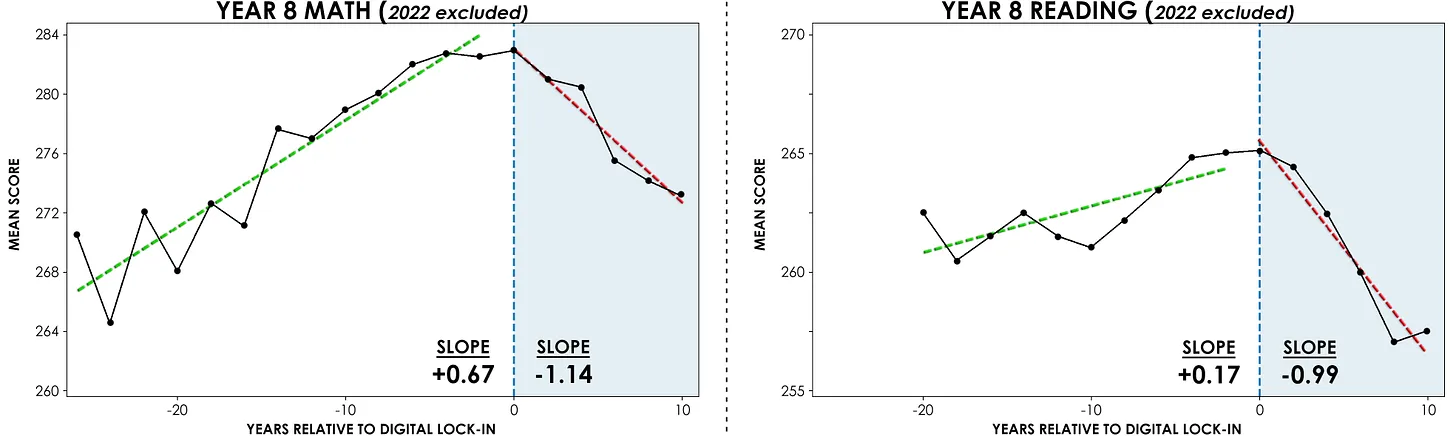
“Across state after state, scores in both 4th and 8th grade rose steadily… prior to large-scale digital adoption. After adoption… [they] shift — often sharply — toward decline.”
Average yearly declines after digital expansion:–1.36 points (4th grade math)–1.07 points (4th grade reading)–1.76 points (8th grade math)–1.07 points (8th grade reading)
Declines were larger in higher grades, aligning with greater screen exposure!
Horvath argues that repeated patterns across states deserve attention. Using a staggered adoption comparison, he writes: “Routine digital exposure in instructional contexts is associated with weaker academic outcomes in a dose-response relationship.” Similar trends appear in PISA, TIMSS, PIRLS, and NAEP data.
While some studies show benefits, he concludes: “There is no robust, internationally consistent signal suggesting that routine classroom digital exposure systematically improves learning outcomes.”
The Bigger Question
Beyond scores, researchers are examining how screen use affects attention and memory. More should be explored on how educational technology has rapidly reshaped classrooms and the quality of teaching, and how excessive technology use could be undermining kids’ learning and attention spans.
The issue for voters is not whether schools need technology, but how much actually improves learning. As new funding proposals emerge, the debate is shifting from “more technology equals better education” to a more nuanced question:
How much technology helps—and when might it start to hurt?
[This article was written with the help of AI. See our polices on the use of AI as a supportive tool.]
Members Discussion
Highline Journal Comment Guidelines
We believe thoughtful conversation helps communities flourish. We welcome respectful, on-topic comments that engage ideas, not individuals. Personal attacks, harassment, hateful comments, directed profanity, false claims, spam, or sharing private information aren't allowed. Comments aren't edited and may be removed if they violate these guidelines.