Local
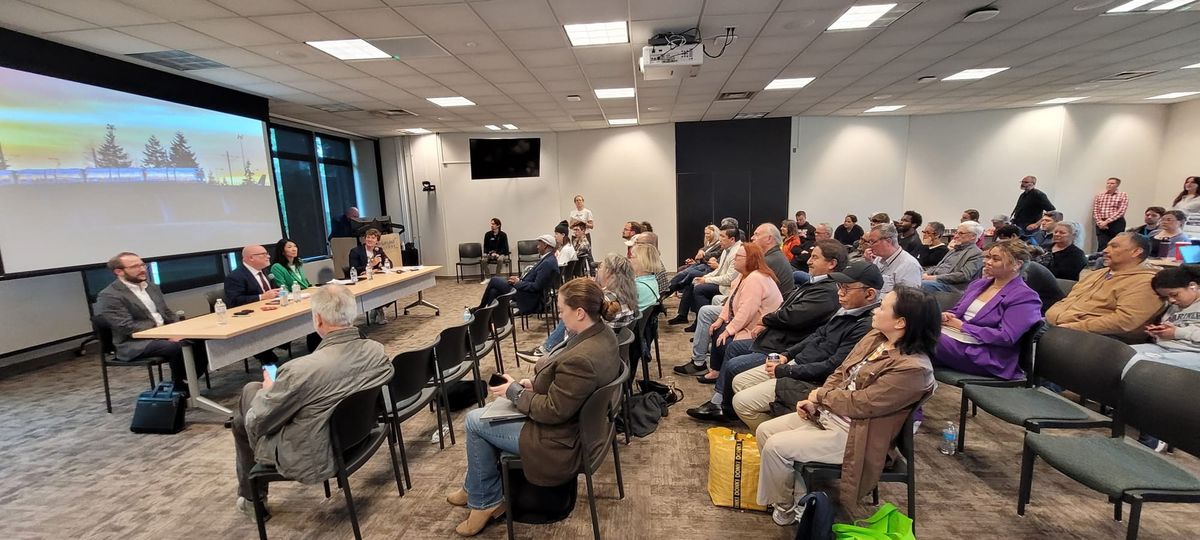
A Highline College forum examined Sound Transit’s estimated $34 billion shortfall, with major questions about costs, delays, parking, debt, transparency, and long-term sustainability left unresolved.
Approximately 80 people attended a forum held May 13, 2026 on challenges facing light rail expansion. There were four speakers. The two who spoke the most as a panel were Sound Transit board members Steffanie Fain, who is also a member of the King County Council, and Thomas McLeod, mayor of Tukwila.
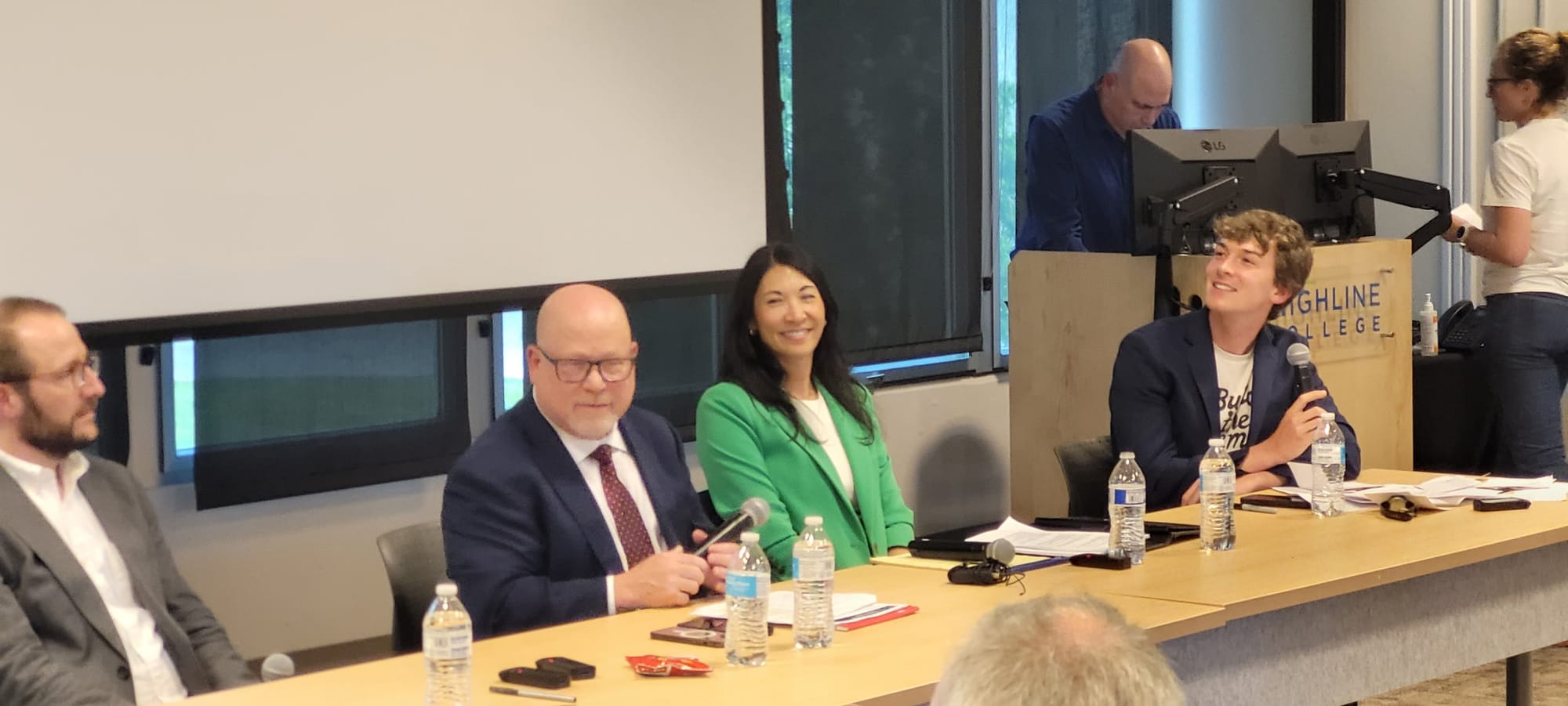
In addition, King County Executive Girmay Zhillay gave some introductory comments, and Sound Transit employee Alex Krieg, assistant director of the Enterprise Initiative, participated part of the time in the panel with Fain and McLeod. Sound Transit CEO Dow Constantine was spotted outside the meeting looking in, but he apparently only stopped by for a few minutes and did not make any comments.
This meeting was one of several being held around the region. Many of these have been covered elsewhere, for example, here is a meeting report about a forum held at Seattle City Hall on May 5. The forums are sponsored by Transportation Choices Coalition and moderated by Holden Minor Ringer. The complete list of forums is here.
Call for Transparency
Most of the meeting was in a question and answer format. Most noteworthy to me was the repeated mention of “we need more transparency.” This word was used several times, including with descriptions of finances, decision making, and ongoing communication.
In the meeting, there was a mention of a way to save a half billion through a different station design (for more details, see the Urbanist story above). But this is a drop in the bucket. On May 7, the board heard a proposed update. This is the slide deck they received on May 7 that they are discussing May 14 and then, as outlined on slide 45, will vote on at their next meeting of May 28.
Lack of Budget Numbers
Also noteworthy, and illustrating the challenges of being transparent, was the lack of numbers. The Enterprise Initiative is a process of looking at how to cut $34.5 billion from the budgeted costs to build the light rail expansion while also looking at all agency costs in a holistic manner to get as close as possible to the projects voters were promised in 2016.
The proposal does not cancel any projects, but some are deferred far out to the future, for example 2050 for Issaquah to Kirkland. But there are no numbers of how much margin there is to handle further project cost increases, or margin for slower than forecast growth in tax revenues.
“The Last Mile…”
One of the major questions was about access and “the last mile.” How can people get to the station? Metro King County bus has recently wrapped up a two-year South Link Connections project, but Fain pointed out the length of the project makes it hard for citizens to understand and provide current input.
Another last mile project is parking. Fain mentioned that the cost of each parking space in a garage approaches $200,000. This can vary depending on land costs and other factors. But she emphasized that parking is very important in south King County, the region does not have the frequency of buses that many areas of Seattle have, and that is not likely to change given our area’s lower density. She specifically mentioned a parking structure proposed in Renton that could be very helpful for commuters. The project list just has “parking fund” as a partially funded item and that’s for the entire system. The deferred projects include STRIDE parking. That’s the bus that is supposed to run along 405, and was supposed to start a few years ago but got deferred so the entire system could run on electric buses, not the carbon-based buses planned for in the original proposal.
Equity
Equity is a guiding principle. The panel discussed the definition of equity. Fain emphasized the importance of having public transportation available to people who do not have any options other than public transportation to get to work, school, appointments, shopping and more. The availability of this transportation, to her, is equity.
Neither panelist raised the issue of what equity means for capital cost investments. For example, the West Seattle light rail project is a spur, with minimal chance of ever being extended, yet it costs billions per mile to build. Is that the most equitable use of funds? Is it more equitable to build all the way to Ballard but not to West Seattle, or to have a line that ends at Seattle Center but goes to West Seattle (albeit without one of the originally promised stations)? Look at the list of deferred or partially funded projects and decide for yourself. These are hard tradeoffs.
Fare Revenue
Another topic was fare-generated income. Bottom line: fares are a minor source of revenue to cover operating costs. While inflation in construction costs is a factor driving higher overall costs, another factor in the cash crunch is that there’s a big gap between operating costs and revenues. When the trains are covering more miles, the costs of total operations increases, but since density in the outlying areas is much lower, there’s lower fare recovery, and therefore higher taxpayer subsidies per rider per trip. A discussion item was the tradeoff between ease of access and fare recovery. One of the speakers mentioned that after sports games, they don’t want fare gates slowing people down from getting on the trains. Many of the stations are not easy to “gate” which also reduces revenues.
How Can Voters Voice Opinions?
The board members stated the importance of doing a great job on their choices. Mentioned a few times was that voters may be unwilling to vote for another tax increase in the future unless this project goes really well. Mayor McLeod said “we need to deliver on our promises” and Councilmember Fain emphasized how much the board wants to hear from people.
I later asked her how communication works. Fain said:
- At board meetings, there is a one minute comment time per speaker.
- Send email to board members at their regular, non Sound Transit, email address, such as her county council email address.
- Email the entire Sound Transit board. Before each meeting, those emails are summarized by Sound Transit staff and also the full text of all emails is provided to the board members.
Extended Bond Debt - up to 75 Years
After the meeting, Mayor McLeod and Council Member Fain stayed to answer individual questions. I asked them more about finances. We discussed the tradeoffs of 20, 30, 40 and 75 year debt. The Sound Transit board asked the state for authority to issue bonds for 75 years, though how much savings per year this would have depends in part on interest rates. There are very few municipal borrowings that go beyond 30 years.
Also we discussed intergenerational equity. I pointed out that a few years ago, Sound Transit sent out reports to the community that had a pie chart. The “sources pie” shows $149.1 billion in sources, including debt of $33.9 billion. I asked them if this meant that in the year 2046, under the original plan, this meant there would be $33.9 billion left to pay off? What would the length of time for that repayment be, 20 or 30 years? They were not sure. This mailer precedes their time on the board.
We discussed how taxpayers in 2050, 2060, 2070 or longer could still be paying the bills for a system they did not get to vote on, and in all likelihood, was voted on before they were born, yet they are stuck with paying it off even if technological advances or other transitions make it obsolete or a poor use of money.
Comparison to BART in Bay Area - Financial Distress
The people I talked with were not aware of the dire straits the Bay Area Rapid Transit system is in. At one point, BART was covering 80% of operations costs from fares, but that percentage has dropped dramatically post Covid and post Covid grants from the federal government making up the difference are now ended. According to this story, voters in the Bay Area are now facing a choice of another significant sales tax increase or closing 15 out of 50 stations, ending service at 9 pm and having trains at the remaining stations operate much less frequently. Caltrain, which operates from San Jose to San Francisco, is also in financial distress and the vote would provide some funding for it as well.
Tough Tradeoffs Ahead
All in all, every possible station, line extension and project has a constituency. This is going to pose very hard tradeoffs for the board in their vote on May 28.
Members Discussion
Highline Journal Comment Guidelines
We believe thoughtful conversation helps communities flourish. We welcome respectful, on-topic comments that engage ideas, not individuals. Personal attacks, harassment, hateful comments, directed profanity, false claims, spam, or sharing private information aren't allowed. Comments aren't edited and may be removed if they violate these guidelines.